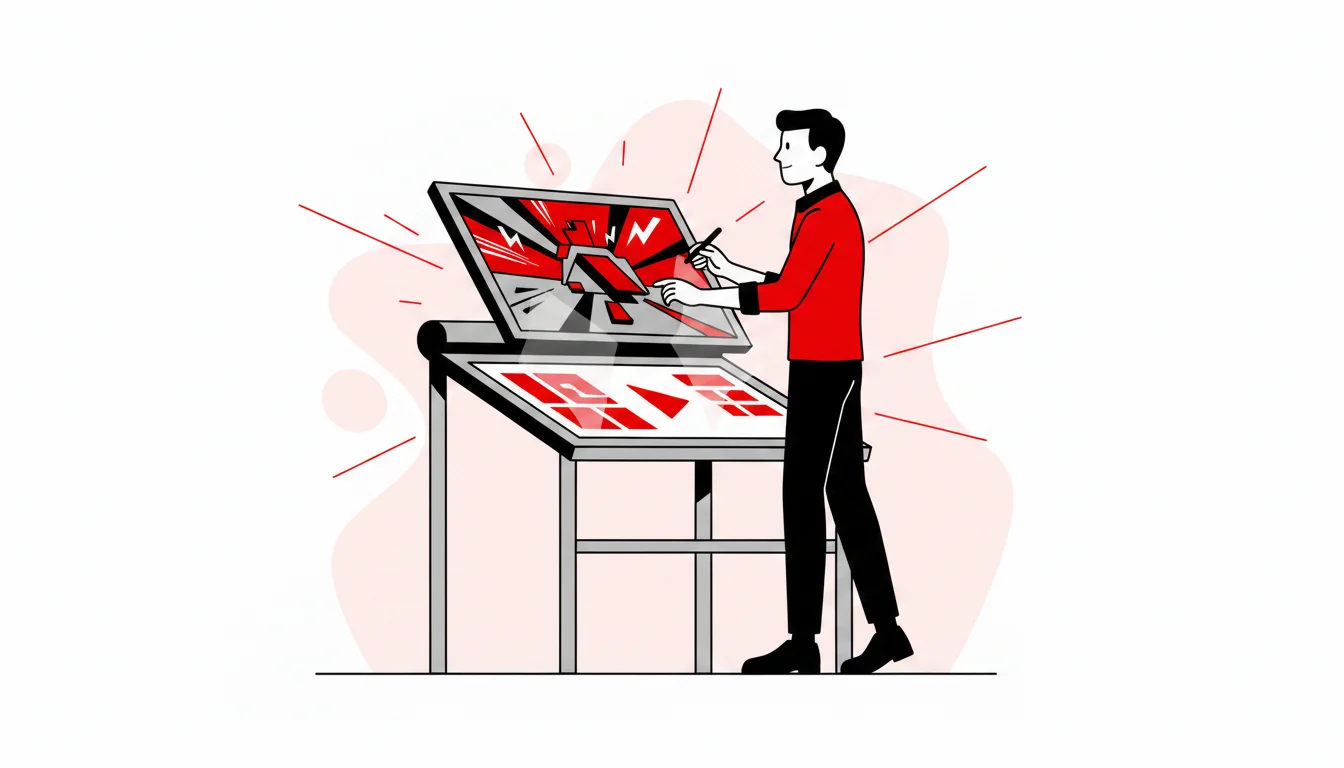
A comic that moves. Motion comic is the format that takes the story off the page — and puts it in the video, with camera, sound and time. It is not full animation, and that is exactly what makes it interesting: it keeps the comic aesthetic and gains the reach of video.
And there is real demand: the term shows up frequently among the searches that reach my site, and the format is a recurring topic in animation research. Here is a guide, from concept to delivery.
What is a motion comic
A motion comic is the form of animation that appropriates the narrative and artwork of an existing comic and transforms it into a screen-based animated narrative. That is the definition Craig Smith consolidated in the animation field — motion comics are, by nature, a hybrid format, “remediating” the printed page into the time of the screen.[1]
In practice: the panels are still there, with their speech bubbles and drawings — but the camera moves through them, elements gain subtle motion, sound creates atmosphere, and reading becomes a directed experience. The reader no longer controls the pace of the page: time now belongs to the director.
That places it in a specific position, between two worlds. It does not have the frame-by-frame production of full animation (which requires drawing each pose, as in rotoscoping), nor the reading freedom of a static comic (which the reader explores at their own pace). It takes the comic’s art and organizes it in the time of cinema.
The difference from traditional animation
| Motion comic | Traditional animation | |
|---|---|---|
| Art | Static illustrations (comics) reused | Every pose drawn or rigged from scratch |
| Production | Assembly, camera and timing over existing art | Frame-by-frame or full rigging |
| Cost | Lower — art is not redrawn | Higher — every second is produced |
| Aesthetic | Comic’s preserved (line, hatching, bubbles) | Free, continuous |
| Production time | Days to weeks | Weeks to months |
That is why the motion comic is an entry point for anyone with a comic story who wants to take it to video without producing full animation from scratch.
How it’s made (process + free software)
The workflow I use follows the same principle as my 100% free pipeline: illustration, assembly and sound without proprietary licenses.
1. Illustration of the panels. Panels can come ready (an existing comic) or be created for the format. Krita and Inkscape handle drawing, lettering and finishing. For the workflow inside Krita, I gathered the tools into a comics plugin for Krita. If the art exists on paper, it goes through scanning and line cleaning.
2. Assembly and camera. In the format’s most common 2.5D workflow, panels become planes and the camera travels through the scene, with parallax separating layers in depth. The right movement in a motion comic is the subtle one: a zoom into a speech bubble, a slow camera drift, an element that “breathes” to give life.
Timing is everything — and it is what separates a motion comic from a slideshow with effects.
3. Sound. Music, ambient noise and, when the script asks for it, voice-over. Sound is what turns the experience from “watching frames” into “feeling a scene” — this is where the format gets closest to cinema.
4. Export. The result leaves as a video, ready for platforms, event screens or embedding in pages.
One detail that sets my work apart: while most motion comics use flat 2D animation with parallax, I build real 3D scenes in Blender — environments with depth, physical lighting and total camera freedom, without losing the comic aesthetic. That is documented on my service page.
Videos: the process in Blender
Two tutorials show both paths inside Blender. The first is the closest to what I do in this format: giving 3D volume to a comic page.
3D depth in a comic page. Alimayo Arango shows the process of taking 2D art into a scene with depth layers and camera movement. The video is from an older Blender version, but the principle is the same:
Video: "How To Animate 2D Art Motion Comic Page", by the Alimayo Arango channel (YouTube)
Moving comics with Grease Pencil. For the 2D path inside Blender, this tutorial shows the “moving comics” workflow with Grease Pencil:
Video: "Making Moving Comics with Blender Grease Pencil", by the Franklin chinonso channel (YouTube)
Parallax 2.5D: the most common approach. To compare with what I do, this tutorial shows the 2.5D parallax workflow in Blender, which is the path most motion comics take: layers gain depth and the camera travels through the scene.
Video: "Parallax 2.5D Animations in Blender for Beginners", by the Sean O'Skea channel (YouTube)
Comics in Blender with Grease Pencil. For those who want to see the comic-making process inside Blender, this livestream by Paul Caggegi (CG Cookie) talks about the PANELS course, which builds a full comic book with Grease Pencil:
Video: "PANELS: creating a comic in Blender", by the CG Cookie channel (YouTube)
Where it works
The format has three natural territories:
Campaigns and marketing. The comic aesthetic communicates in an accessible, memorable way. For products, processes or messages that ask for explanation, the motion comic delivers what a conventional corporate video does not: the charm of illustration with the distribution power of video.
Education. Educational content in animated comics has a concrete advantage: sequential narrative organizes information in steps, and motion draws attention without becoming fireworks. It is a format that respects the viewer’s comprehension time.
Entertainment and authorial narrative. This is the format’s original territory — from Watchmen adaptations to independent productions. For anyone with a comic story who wants to see it alive, without producing a full animation feature, the motion comic is the way.
Cost / timelines
A motion comic is cheaper than full animation — but it is not cheap: production involves assembly, camera direction, sound and revisions, and that is real work. The comparison:
- Motion comic of 1-2 minutes: production in days to a few weeks, with cost concentrated in assembly + sound + direction
- Full 2D/3D animation of the same material: weeks to months, because every second is drawn or rigged from scratch
To estimate your project, the budget calculator is a good starting point — and, like any audiovisual project, the real price depends on scope: number of panels, movement complexity, original or licensed sound, deadlines.
FAQ
What is a motion comic?
It is a hybrid format that takes the narrative and artwork of a comic and transforms it into a screen-based animated narrative — with camera, subtle motion and sound. It sits between the printed page and full animation.
What is the difference between a motion comic and animation?
In traditional animation, every pose is drawn or rigged from scratch. In a motion comic, the comic’s art is reused — the work is in assembling, directing the camera and timing. That is why it is faster and cheaper, keeping the comic aesthetic.
What software do you use to make a motion comic?
With free software: Krita or Inkscape for the art, Blender for assembly and camera, and Audacity for audio. The complete flow is in my 100% free pipeline.
How much does a motion comic cost?
Less than full animation of the same material, but it is real work: assembly, direction, sound and revisions. Use the budget calculator as a starting point.
Do motion comics work for marketing?
Yes — the comic aesthetic communicates in an accessible way, and the format works well for explaining processes, products and messages that ask for a clear visual narrative.
References
- Smith, C. (2012) Motion comics: Modes of adaptation and the issue of authenticity. Animation Practice, Process & Production, v. 1, n. 2, p. 357-378. DOI: 10.1386/ap3.1.2.357_1. (Defines motion comics as the appropriation and remediation of a comic’s narrative and artwork into a screen-based animated narrative.)
- Chen, L.; Li, S.; Li, Z.; Li, Q. (2025) DancingBoard: Streamlining the Creation of Motion Comics to Enhance Narratives. Proceedings of the 30th International Conference on Intelligent User Interfaces (IUI ‘25). DOI: 10.1145/3708359.3712167. (Research on 95 online motion comics and surveys with creators; documents applications in storytelling, education and advertising.)
Notes
- Own experience — motion comics production with real 3D scenes in Blender, documented on the service page.
If your project asks for the impact of the comic with the reach of video, get in touch — and if you have the story, I have the process.
— Ricardo A. B. Graça · ricolandia.com
📝 Post updated on 10/14/2026.