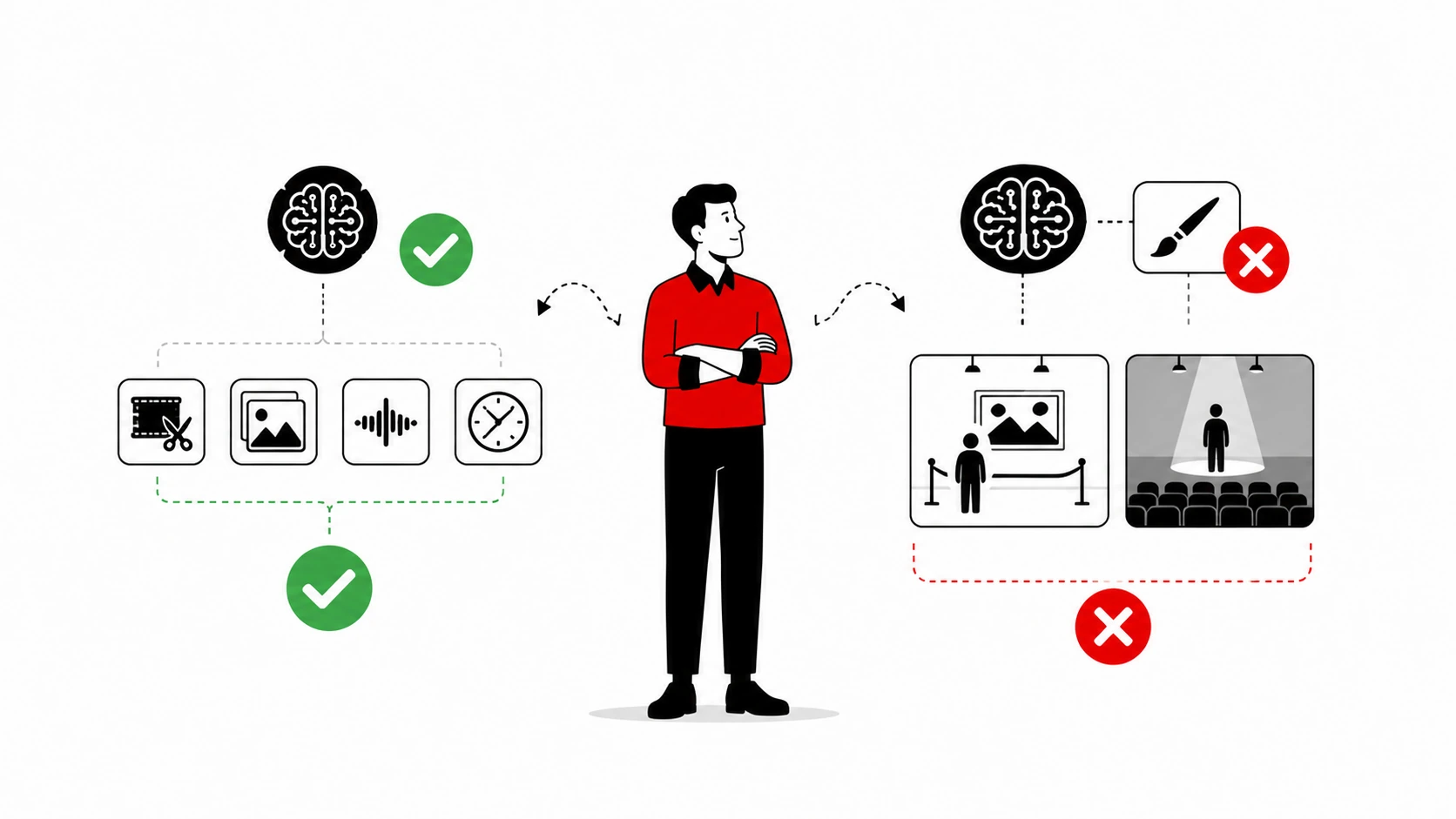
AI can be useful in audiovisual, but not in creating art. Where it actually works is in repetitive, tedious, bureaucratic tasks. It is a simple distinction, and the market keeps confusing the two.
Where AI actually helps
Generative AI and machine learning tools are excellent for mechanical, repetitive and organizational tasks. A review published in Artificial Intelligence Review concludes that maximum benefit from AI in creative industries will come where it is designed to augment, not replace, human creativity.[1] In my pipeline, these are the ones that make a real difference:
Detecting music beats for editing. Audio analysis tools identify BPM, time signature and transitions with precision — the editor no longer has to mark each beat manually. But the decision to cut on the beat or against it, to speed up or slow down the pacing, is still human.
Generating automatic captions. AI transcription today is fast and cheap. For corporate videos, lessons and social media content, it delivers a first draft in minutes. But automatic captions need to be reviewed — proper names, technical jargon and client-specific terms are frequently wrong. AI drafts. The professional delivers.
Initial reference research. Instead of spending hours gathering visual references, AI can assemble a first set of images, styles and references based on a description. The professional selects, organizes and directs from there.
Assisted production scheduling. Based on duration, animation type and team size, AI can estimate timelines consistently. Studies show AI integration is most effective in standardized processes — efficiency gains in post-production, marginal impact on creative stages.[2] Tools like the Production Timeline Calculator I have on the site do exactly this. The value is not in the math — it is in knowing which variables to include and how to interpret the result.
Transcribing meetings and scripts. Transcribing a briefing meeting or a recorded script is grunt work. AI does it in seconds. The professional gains hours per week.
Organizing and tagging takes. Tools that auto-tag footage identify objects, people and scenes in video files. For those working with large volumes of material, this turns days of organization into minutes. Same logic applies to upscaling — increasing resolution of old footage, render denoise, and reference images is legitimate, as long as the result is not sold as final material.
Assisted color correction. AI color grading tools suggest initial corrections. The colorist starts from a better place than zero, but the fine-tuning — the emotional intention of the palette — remains a human decision.
Files and backups. Automating project organization, versions and backups is where AI adds the most value with the least risk. No creative decisions are at stake.
Where AI does not matter
Every task above involves execution. None involves creative decision. Researchers who reviewed dozens of studies on human-AI collaboration in design observe that the core creative cycle — continuous interaction between creation and reflection — remains unchanged, even with generative tools.[3] And that is where AI does not enter — not because it cannot generate something that looks interesting, but because it does not know why it is doing it.
Directorial decisions. Why this shot and not that one? Why the close-up here and the wide shot there? The answer is not in training data — it is in narrative intention, in what you want the viewer to feel at that exact moment. AI has no intention.
Animation timing. Where to stretch a movement for weight, where to speed up for impact, where to hold a pose for the joke to land — this is not calculated, it is felt. AI calculates the most likely transition. The animator chooses the most expressive one.
Narrative structure. The character arc, the dramatic turn, the subtext of the dialogue — AI can generate text that looks structured, but it does not know why the protagonist needs to change by the end. Not because it is incapable, but because it does not have to. Narrative without internal need is decoration.
Aesthetic choices. Why this frame and not that one? Why this palette and not that one? The answer is not technical — it is expressive. AI chooses the most probable. The artist chooses what means something.
Editing — emotional rhythm. Cutting to the beat is a task. Knowing where to cut so the viewer feels exactly what you want them to feel at that specific frame — that is editing. AI can analyze pacing patterns, but it does not decide based on emotional intention — it decides based on probability.
The danger of mistaking task for art
When companies treat tasks (which AI does well) as if they were art (which AI does not do), the result is pasteurized content — technically correct, emotionally empty.
And when professionals treat art as if it were a task — “just generate another video following the same template” — they lose their edge. The client who wants volume hires AI. The client who wants impact hires someone who decides.
AI drafts. The professional delivers. The confusion starts when someone thinks the draft is the final product.
What this means for the professional
Automate the tasks. Use AI for transcription, organization, timeline estimation, beat detection. Every hour saved on a task is an hour available for creative decisions.
Charge for decisions, not execution. The professional’s value is not in knowing how to operate the software — it is in knowing which button to press, when and why. AI presses buttons. You decide which ones.
The professional of the future is not the one who uses AI. It is the one who knows when not to. Knowing where AI gets in the way — where statistical predictability destroys expressiveness — is what separates those who understand tools from those who understand art.
Studying is still the differentiator. Pushing buttons is something anyone can do.
Frequently asked questions
Will AI replace video editors?
Not the editors who make narrative decisions. It will replace those who only operate software. Editing is not cutting takes — it is deciding which take tells the story.
Do AI music beat detection tools actually work?
Yes, for basic BPM and time signature detection. But the decision to align the cut to the beat or against it, to create syncopation or tension, remains the editor’s.
Does automatic captioning replace captioning work?
It replaces typing. It does not replace review. For professional content, every automatic caption needs to be reviewed — names, jargon and context still get it wrong.
How do I know if I am using AI for task or art?
Ask: is this tool executing something I could do on autopilot, or is it deciding something that requires judgment? If it is execution, use AI. If it is a decision, it is yours.
I use several of these tools in my pipeline. The Briefing Generator and Production Timeline Calculator are examples of AI applied to tasks — organization and estimation — not to creative decisions. For screenwriting, Fonte keeps the process offline, where no AI interferes with what you write.
I produce animation with AI on tasks and human decisions on art. Get in touch if you’d like to discuss your project.
— Ricardo A. B. Graça · ricolandia.com
References
- Anantrasirichai, N.; Bull, D. (2021) Artificial intelligence in the creative industries: a review. Artificial Intelligence Review, 55, 589-656. DOI: https://doi.org/10.1007/s10462-021-10039-7
- Chen, Y. et al. (2024) The Effect of AI on Animation Production Efficiency: An Empirical Investigation Through the Network Data Envelopment Analysis. Electronics, 13(24), 5001. DOI: https://doi.org/10.3390/electronics13245001
- Hughes, R. T.; Zhu, L.; Bednarz, T. (2021) Generative Adversarial Networks–Enabled Human–Artificial Intelligence Collaborative Applications for Creative and Design Industries: A Systematic Review. Frontiers in Artificial Intelligence, 4, 604234. DOI: https://doi.org/10.3389/frai.2021.604234