Every conversation about AI in art starts in the wrong place. The question is always what the machine does in the artist’s place. The image? The video? The voice? For anyone who makes a living from creation, the answer tends to be the same: nothing decent without a person deciding.
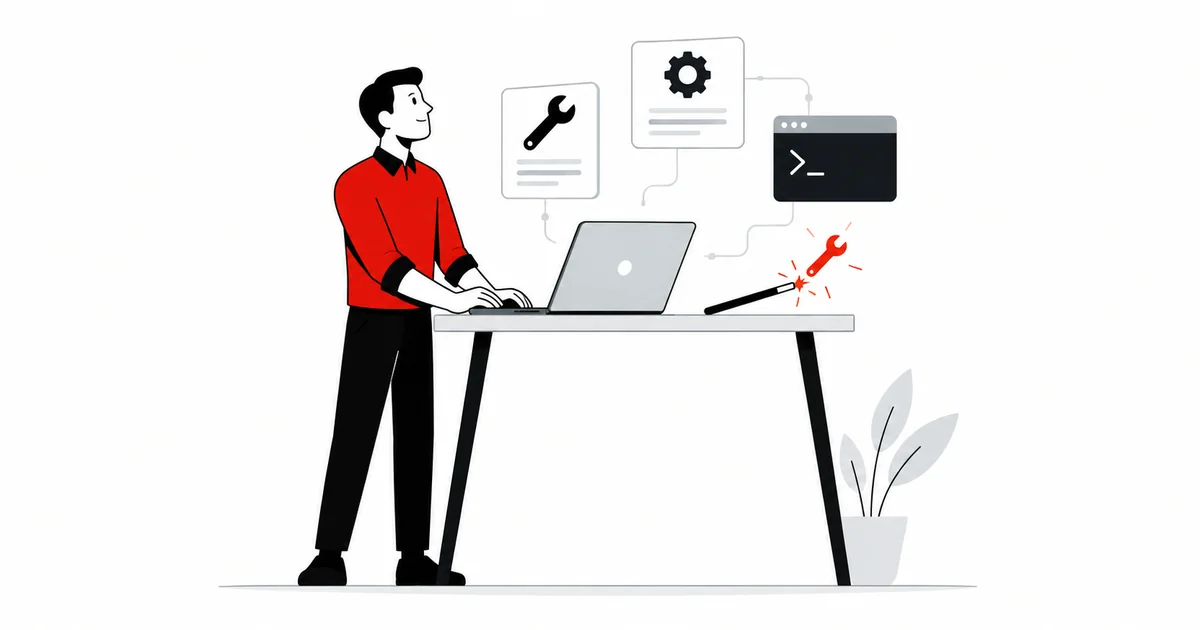
There is another question, less glamorous and more useful: what can AI do for the artist without making the art? In my case, it writes code. It is the same technology that generates images, applied one floor below: at the workbench, in the tools I use to work. The spell against the sorcerer.
Two AIs, two places
Generative image AI works in the place of the result: it produces the drawing or the scene. Its error is invisible until someone with a trained eye looks and says it is wrong. No test proves whether the hand has the right proportion or the light comes from the right side. If the drawing says what it needed to say, only the eye knows. The evaluation is the eye.
Code is the opposite. The AI writes a function, and the function runs or it does not. Tests pass or fail. The build breaks or it does not. The error shows up in seconds, with a line number. That changes the nature of the use: with code, AI can be wrong a lot, because the error is cheap to find and fix. In art, the expensive error is the one nobody sees.
That is why I use AI in the tool, not in the work. The tool has proof. The work has judgment. I have written about this boundary in AI and audiovisual and about what happens when art becomes a shortcut in the devaluation of art.
What it does well at the bench
I am not a programmer. What I had were production needs. A screentone that would not blow up in print. A script that would not lose the cultural project. A site that would not depend on subscriptions. For years, those ideas stayed in the notebook, as sketches of tools I did not know how to build.
AI did not turn me into a programmer. It helped me cross the part I always got stuck on: the code. HQ Tools and Fonte were born that way, from a problem in my own workflow, not from a wish to make software. Then came the scripts on this site, for the same reason: solving what was in front of me.
The gain is not raw speed. It is surface area: ideas that used to die as sketches now become tools. I say what the tool needs to do. I test it as a user. I decide whether it works. The build and the test say if it runs; use says if it is worth it. AI does not replace the programmer. It let me reach the tool I already knew how to draw on paper.
ArtCraft and the right target
ArtCraft is the clearest example of the target. Thirteen free applications, in Rust, under the Apache-2.0 license, rebuilding what is sold by subscription today: image, vector, video, effects, layout, interface, text, audio, presentations, spreadsheets, PDF, CAD. I do not know whether AI took part in their code. It does not matter for the argument. What matters is that the result is auditable: anyone can read it, compile it, fix it, fork it.
An AI-generated image cannot be audited: either you like it or you do not. A program can. And that difference is what makes the tool the place where free software can compete on equal terms, even when the model helping to write it is closed. I made the case for that in free software as access.
The spell has a price
Using the sorcerer’s tool charges a price, and it is better to say what it is.
Dependency comes first: if the model is a closed API, the code it helps write depends on a company that can change the price and the rules. In my case, I use only open-weight models, such as DeepSeek’s: they can run on my own machine and are not tied to a single company. Even when the call goes through an API, the model is open, and the day the machine can handle it, it runs locally. The discipline is the same: client briefings and unpublished scripts stay out. API keys, even more so. I wrote about that risk in the hidden cost of ready-made AI.
Then debt: code generated without tests and without an owner is a liability, not an asset. AI writes fast; maintenance stays human. A project nobody understands is worse than a project that does not exist.
Licensing is the last one: ownership of generated code varies with jurisdiction and with the model’s terms. When in doubt, review. Then document. Free software with an obscure license is not free.
The counterattack
Every hour of AI used to build a tool other people use is an hour not spent generating slop. It is a small trade, but it is a trade.
The spell against the sorcerer is not banning magic. It is using it to build the workshop: the tools that remain, that anyone can open and improve. Art remains what the machine does not do: the decision.
Frequently asked questions
Can AI write reliable code?
It can write code that passes tests and solves the problem, as long as someone reviews it and the build proves it. What it does not do is take responsibility: the owner of the code is still whoever signs the commit.
Isn’t that using the enemy’s tool?
It is using the tool of those who want to concentrate. The difference is what you do with the result: closed code nobody reads, or a free tool anyone can use.
Who owns AI-generated code?
It depends on the jurisdiction and on the model’s terms. In practice, treat it as your code: review it and document it. The license comes after. If the model’s license is restrictive, the code born from it may be too.
Do I need to know how to program to do this?
To use a coding agent, no. To review what it writes, yes. The minimum is understanding what the program does and why it does it.
Does this replace the programmer?
No. I am not a programmer; AI helps me reach the tool I needed. Whoever designs systems in depth remains the programmer.
References
- ArtCraft. Crafting Apps — 13 free applications in Rust, Apache-2.0 license. getartcraft.com/apps (accessed on 28/10/2026). Code: github.com/storytold.
- Own experience — maintaining free tools (HQ Tools, Fonte and the scripts on this site) with coding agents (2024-2026).
- Free software as access: democratization with privacy and autonomy.
If you want to take an idea off the paper with free software, get in touch.
— Ricardo A. B. Graça · ricolandia.com