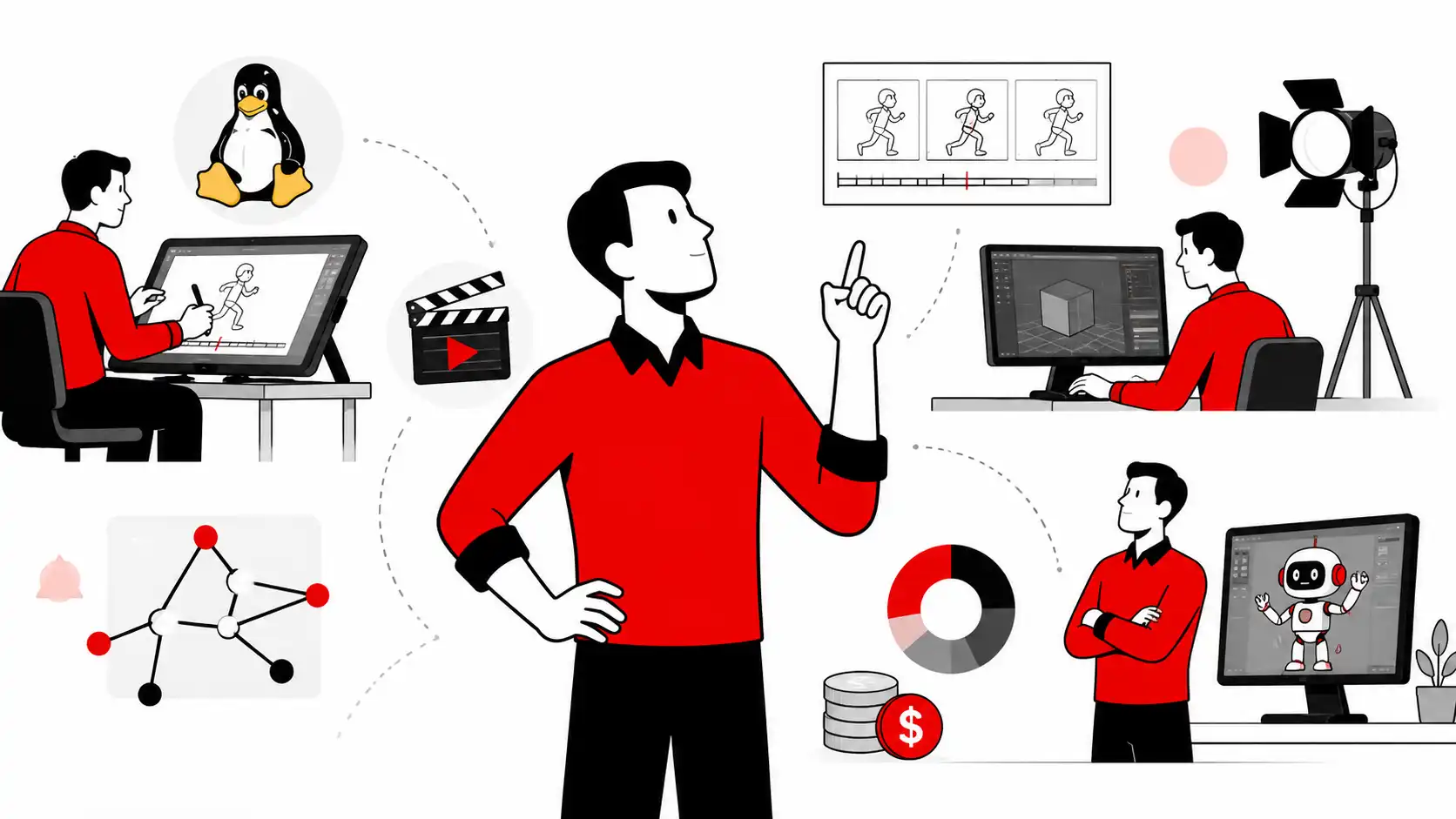
When a company decides to invest in animation, the first decision isn’t about visual style — it’s about who will produce it. Choosing an animation studio involves evaluating portfolio, timeline, budget, and increasingly, the production infrastructure.
One question few consider early on: does the studio use proprietary or free software? This directly impacts cost, flexibility, and even long-term project continuity.
What makes an animation studio
An animation studio transforms a concept, script or brief into an animated video. This involves scriptwriting, storyboard, character design, 2D or 3D animation, scene composition, sound design and finishing.
Within this workflow, the choice of production tools isn’t just a technical decision — it’s a business decision. Each proprietary software license represents a fixed recurring cost that enters the project budget year after year, regardless of how much creative work is being delivered.
How free software changes the budget
An animation studio that operates with free software — Blender, Krita, Inkscape, Kdenlive — has a different cost structure from one dependent on Adobe, Maxon or Autodesk licenses. The difference isn’t in output quality, but in what the client pays.
To visualize the scale: an annual Adobe Creative Cloud Pro subscription, which includes Premiere Pro, After Effects, Photoshop and Illustrator, currently costs about US$ 840/year per user on the individual plan.[1] In the 3D world, the picture is heavier. An annual Autodesk Maya license runs around US$ 1.875 to US$ 1.945 per workstation,[2] and Maxon Cinema 4D costs approximately US$ 840/year on the annual plan — or nearly double that on a monthly basis.[3] None of these figures include plugins, additional render farms, or the support and training costs that typically accompany such pipelines.
At a traditional studio, a significant portion of the client’s budget covers these licenses before a single hour of creative work is produced. At a free software studio, the same amount goes entirely into animation hours, revisions, and finishing. For the client, this means more animation for the same investment, or a more competitive price for the same scope — not because the work is worth less, but because the cost structure is different.
Free software is no longer synonymous with “lesser alternative”
For years, the argument against free software in professional production was output quality. That argument no longer holds. In January 2026, Netflix Animation Studios — which includes visual effects studio Animal Logic — became the first major animation studio to join the Blender Development Fund at the highest corporate patron level, alongside companies like Epic Games, NVIDIA and AMD, with a commitment of at least €240,000 per year.[4] According to Netflix, Blender is already part of the company’s production pipelines in films, series, and visual effects work.[5]
This is not an isolated case. Productions such as Next Gen (Netflix) were described by the studios behind them as “effectively 100% Blender”,[6] and the software was also used in Love, Death & Robots and Undone (Amazon Prime Video).[7] Pixar had confirmed years earlier that Blender is one of the third-party tools supported internally for production use.[7]
In my own experience — over twenty years producing corporate animation exclusively with Blender, Krita, Inkscape and Kdenlive — this maturation is confirmed in practice: deliveries for clients with commercial deadlines and quality standards, without the tool ever being the limiting factor.
Beyond cost: the vendor lock-in question
There is a second argument, less discussed but equally relevant for anyone hiring: what happens when the software provider changes the rules of the game. This is the classic problem of vendor lock-in — dependence on a single provider that may, at any point, raise prices, discontinue a tool, or change its licensing model, leaving the client without an immediate alternative.[8]
This is not a hypothetical concern. The recent history of price increases and plan restructuring in creative production software — including Adobe itself, which has adjusted prices and merged its “All Apps” plans into more expensive tiers — shows this risk is concrete for any studio that builds its entire operation on proprietary licenses.[9] When a studio operates with free software, this risk simply doesn’t exist in the same way: the code is available, the file remains open, and work continuity does not depend on a single company’s pricing policy.
2D vs 3D animation — which is right for your project
Not every animation studio delivers both formats with equal quality. The choice between 2D and 3D animation depends on the project’s goal:
2D animation is ideal for explainer content, social media videos, educational series and motion graphics. Cost per minute tends to be lower and production is faster, especially for projects focused on clear communication.
3D animation is recommended for product demonstrations, architectural visualization, simulations and institutional videos requiring depth, texture and realism. Cost per minute is higher, but the visual impact is significantly greater.
A solid animation studio should recommend the right format for each project — not the format that generates the most profit.
How to choose an animation studio
Beyond the portfolio, some practical criteria help with the decision:
- Cost transparency: does the studio detail the budget or deliver a closed figure without explanation?
- Defined pipeline: is there clarity about production stages, revisions and deliverables?
- Technology: does the software used impact the final cost, and is the studio transparent about it?
- Continuity: what happens to your files and your project if the studio switches software vendors, or if the vendor changes licensing rules?
- Communication: is the approval flow clear and does it fit your schedule?
I have been producing corporate animation with free software for over twenty years. If you’re looking for an animation studio for your project, get in touch for a conversation.
— Ricardo A. B. Graça · ricolandia.com
References
- Adobe Creative Cloud Pro costs US$ 69.99/month on the annual plan for individuals in the US (approx. US$ 840/year). Source: Adobe Creative Cloud Pricing 2026, costbench.com.
- Autodesk Maya annual subscription pricing. Sources: Tekpon, Maya Reviews 2026; DigitaLicence, Maya USA 2026.
- Maxon Cinema 4D costs US$ 69.91/month on the annual plan (~US$ 839/year) or US$ 109/month on a month-to-month basis. Source: Drop & Render, Cinema 4D Price 2026.
- Netflix Animation Studios joined the Blender Development Fund as a Corporate Patron in January 2026, with a minimum contribution of €240,000/year. Source: Blender Foundation, official press release.
- Blender is already integrated into Netflix’s production pipelines for films, series and visual effects work. Source: AEC Magazine, “Netflix joins Blender Development Fund”.
- Statement from the co-founder of the studio behind Next Gen (Netflix). Source: Renderosity Forums.
- History of Blender adoption in Netflix, Amazon Prime Video productions and Pixar’s confirmation of internal Blender use. Source: Blender Foundation, “Blender’s impact in film”.
- Definition and risks of vendor lock-in in software. Source: OpenCloud, “Avoid vendor lock-in”.
- Adobe Creative Cloud plan restructuring into Standard/Pro tiers with associated price increases. Source: costbench.com, Adobe Creative Cloud Pricing 2026.