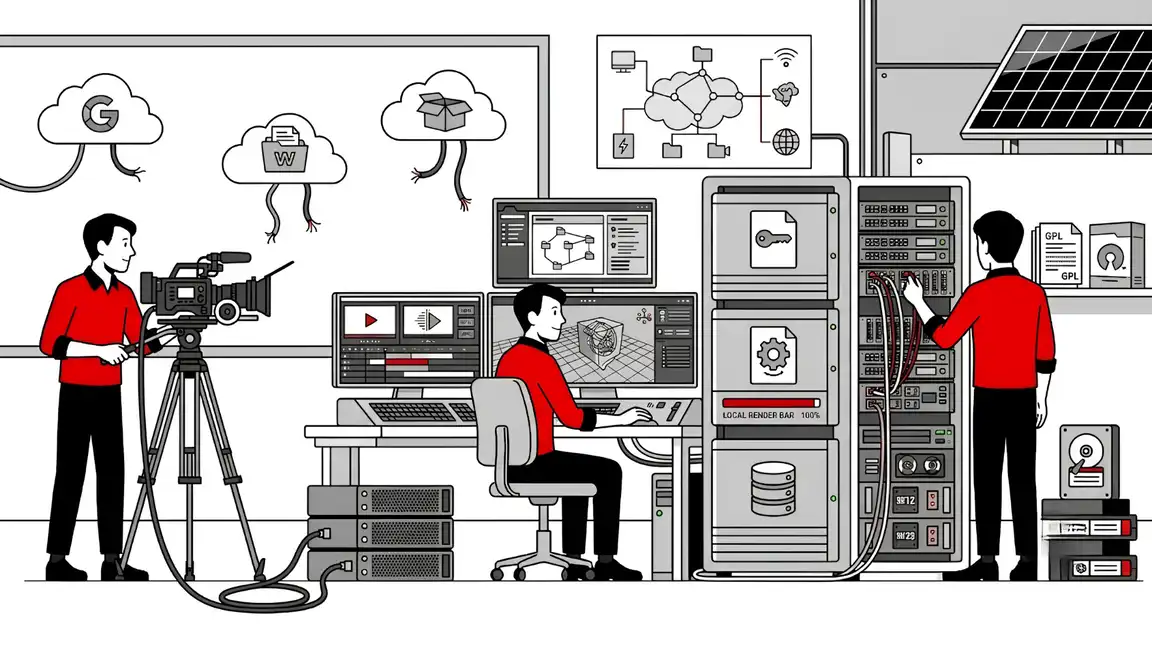
There is a decision that most creative professionals make without realizing they are making it: outsourcing their infrastructure to third parties. Google Drive for files, WeTransfer for deliveries, Notion for management, Slack for communication, Adobe Cloud for production. Each service solves an immediate problem and, in return, you give up data, dependency and — progressively — control over your own process.
I don’t do this. Not out of nostalgia, not out of paranoia. Out of conviction about what it means to have a sovereign creative process.
Production
The entire production chain — capture, editing, animation, rendering — runs on free software installed on machines I administer. Blender, Krita, Inkscape, Kdenlive, GIMP. No license that can be revoked, no forced update that breaks the project midway, no external server that needs to be online for me to work.
Infrastructure
I operate two VPS servers and a local network with a homelab and dedicated render server, all running Debian with Docker. Portainer for orchestration, Nginx Proxy Manager for routing, Watchtower for controlled updates. It’s a stack I understand entirely — which means when something fails, I know where to look.
Delivery
Clients receive files via self-hosted FileBrowser — directly from my server, no intermediaries. No project data travels through third-party infrastructure. Syncthing keeps backups synchronized across local machines. For project management and collaboration, I use Kanboard, also self-hosted.
The cost of invisible outsourcing
Many people don’t calculate the real cost of depending on free services. Google Drive is “free” until you need more storage. WeTransfer is “free” until a client needs to download a 5 GB project within 48 hours. Slack is “free” until you need to search messages from three months ago. The cost appears when scale grows — and by then, migrating is more painful than starting with your own infrastructure.
What this means in practice
It means no company can change their terms of service and affect my production. It means client data stays where I said it would. It means the pipeline that worked yesterday will work tomorrow — because nobody but me decides when it changes.
If you want to start your own journey with free tools, explore the free tools I make available for audiovisual producers.
Digital sovereignty is not an abstract ideological stance. It is the difference between a creative process you control and a creative process you rent.
— Ricardo A. B. Graça · ricolandia.com