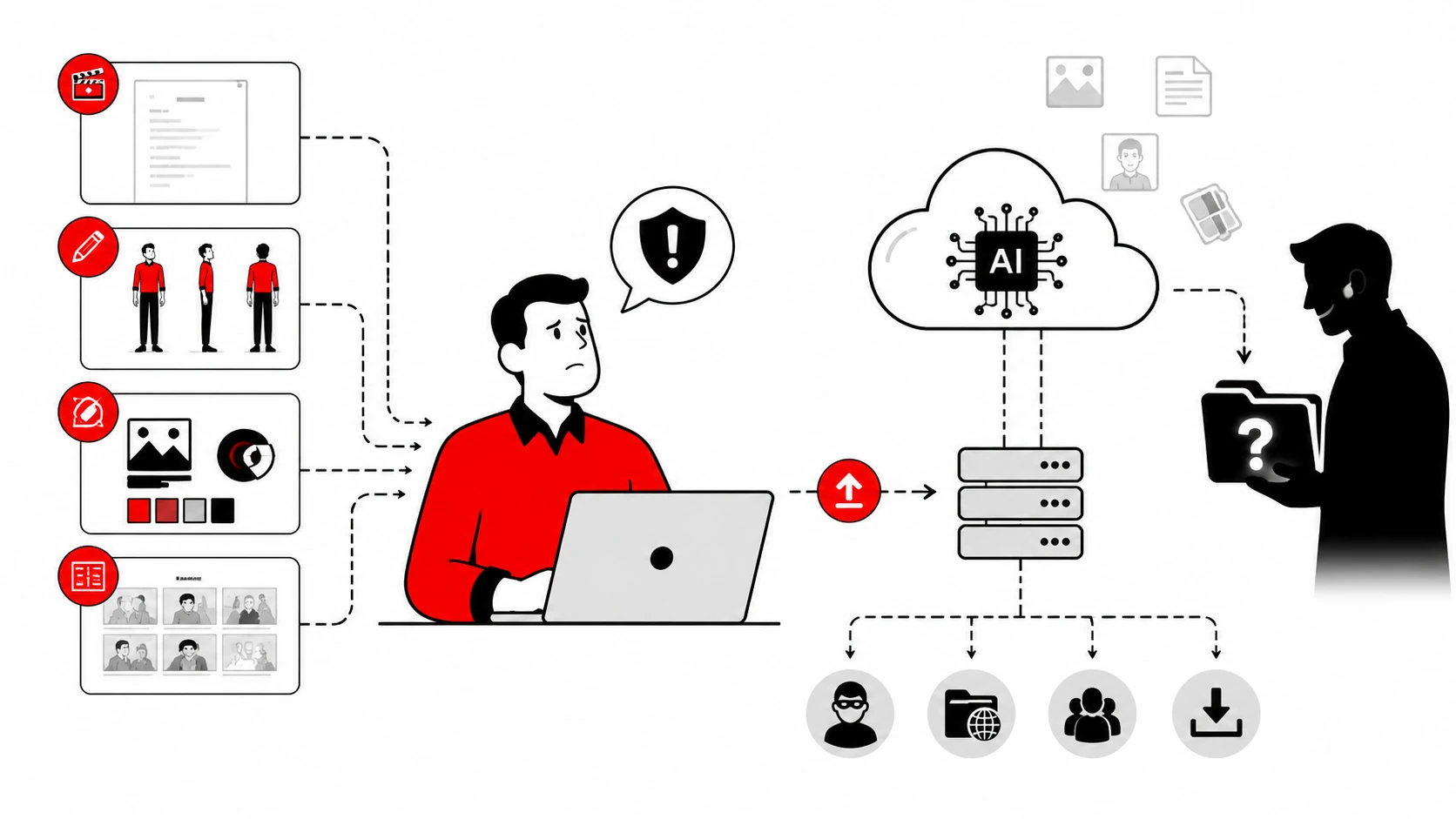
The biggest risk of generative AI for video producers, animators and screenwriters isn’t replacement — it’s involuntary data leakage. Unpublished scripts, character designs that haven’t launched yet, client visual identities that haven’t been approved — all of this may be sent to third-party servers without you knowing exactly what happens to it afterward.
What’s at stake
When a creative professional uses a cloud-based AI tool, they aren’t just generating text or images. They are sending data that may include:
- Screenplays and scripts — intellectual property protected by copyright law, often containing original dialogue, plots and characters
- Unpublished animations — scenes in development, style tests, designs that define the look of a product or campaign yet to launch
- Client visual identities — logos, color palettes, brand guidelines hired under confidentiality agreements
- Briefings and strategies — commercial information about market positioning, target audiences and competitive differentiators
Each of these scenarios involves sending confidential creative material to servers whose data handling policies may not adequately protect it.
How most platforms handle your data
The problem is not theoretical. Researchers have demonstrated that language models can reproduce training data word for word — a phenomenon called memorization. In 2021, a team led by Nicholas Carlini proved it is possible to extract hundreds of verbatim examples from GPT-2, including names, emails and phone numbers the model had memorized.[1] A follow-up study showed this memorization is not accidental: it grows with model size, training data duplication frequency, and prompt context length — and it is far more prevalent than previously believed.[2]
In parallel, Bender, Gebru and colleagues’ ethical critique On the Dangers of Stochastic Parrots argues this phenomenon is not a bug — it is structural. Language models, because they do not understand what they generate (they only repeat statistical patterns), can reproduce sensitive training data with no mechanism for control.[3] The technical demonstration that this is possible came from Carlini’s extraction attacks.
In practice, many platforms use prompts and uploads to refine their models. The script you pasted into a chat to “improve the dialogue” may be used as training data. Even platforms that claim not to train on user data often retain logs and metadata for indefinite periods.
Three paths to protect creative data
1. Gateways with Zero Data Retention
If you need to use cloud models, the first step is choosing a provider that does not store your data. OpenRouter is the best-known marketplace, with over 400 models. It offers a Zero Data Retention (ZDR) mode that, when enabled, routes requests only to providers that retain nothing and do not train on your prompts.[4] It is SOC 2 compliant and supports GDPR. It is not open-source, but it significantly reduces exposure.
There are also direct alternatives:
- Oxlo.ai — fixed price per request (not per token), with explicit ZDR and a guarantee your data is not used for training.
- TextCortex EU — enterprise agent platform based in Germany, data never leaves European jurisdiction. Ideal for GDPR compliance.
- Gooey.AI (Enterprise) — aggregates multiple providers, SOC 2 Type II, supports deployment in your own VPC.
For those who prefer total control, there are self-hosted options you install yourself:
- VoidLLM — lightweight Go proxy that never stores prompts or responses to disk (zero-knowledge by architecture).
- LiteLLM — open-source gateway unifying over 100 providers with a single interface.
- LocalAI — local drop-in replacement for the OpenAI API, runs completely offline.
2. Local models with ComfyUI
This is the path with the most security and privacy: using models that run on your own machine or server. I adopted this route in my animation pipeline. Image and video generation models run locally on my render server. Project files never leave my infrastructure. Quality is comparable to cloud services, cost is predictable (electricity, not API calls), and control is total — though there is an initial hardware investment that cannot be ignored, but when added to the cost of using several online models without any privacy, it becomes cheap.
3. Data protection system
When a project requires external models (whether for quality, variety or deadlines), I use a system (which I created in Python) that does three things before sending any data: alters sensitive information (names, documents, dates, numbers), splits the content across multiple models so that none receives the full context, and reassembles the result locally afterward. Your data never reaches an external server in complete form.
The case of screenwriting
Screenplays are particularly vulnerable because they contain not just text but narrative structure — something a model can generalize and reproduce in responses to other users. The character, the central conflict, the dramatic twist: all of this can be absorbed into the model without the original author having any control or compensation.
Fonte, the Fountain-format screenwriting editor I created, was designed with this concern in mind: it is 100% offline, free and open-source. The script file never needs to leave the author’s machine unless they choose to export it.[6] The Fountain format is plain text, portable across any tool, with no cloud dependency. The script lives where the author chooses.
The cost of not choosing
Not consciously choosing how your creative data is handled is, in practice, delegating that decision to third-party terms of service — which can change at any time, without notice. A platform may start training on your data overnight, a model may be discontinued, a privacy policy may be silently updated.
The risk is not just ethical or legal. It is practical: leaked creative material before launch can cost a project, a campaign, a contract. Digital sovereignty, in this context, is not an abstraction. It is the difference between controlling your creative process and depending on the goodwill of third parties.
The other face of this — the effect of AI on the value of creative work — is in AI, the devaluation of art, and the illusion of creation.
Frequently asked questions
Does using cloud AI mean my data is always exposed?
Not necessarily, but it depends on each provider’s data policy. Platforms with ZDR (Zero Data Retention) like OpenRouter significantly reduce exposure, but not entirely, and local models completely eliminate data traffic. The danger is using any tool without checking its data handling policy.
Can I get quality without sending data to the cloud?
Yes, depending on the task. Local image generation models (via ComfyUI) achieve acceptable quality (depends directly on your hardware). For text, open models like Llama, Qwen and Mistral run locally with good quality. The trade-off is performance and convenience, not final quality.
Are free AI tools safe?
First we need to clarify: free and open source are different things. If it is free but proprietary (closed source), it is risky. Free closed-source tools often monetize through user data — prompts, uploads and interactions can be used to train models, refine products or be sold to third parties. The absence of a price tag does not mean the absence of a cost.
Is Fonte (free and open-source tool) affected by these risks?
No. Fonte is an offline editor. No script data ever leaves the user’s machine. The Fountain format is plain text, with no cloud dependency, no telemetry, no data collection.
If you’re structuring an animation project, start with the Briefing Generator. And to understand how I built my production pipeline with free software and local AI, the post about my 100% free pipeline describes every step. For screenwriting, Fonte is available for free.
I produce animation with free software and self-hosted infrastructure. Get in touch if you’d like to discuss privacy and digital sovereignty in your next project.
— Ricardo A. B. Graça · ricolandia.com
References
- Carlini, N. et al. (2021) Extracting Training Data from Large Language Models. USENIX Security 2021. DOI: https://doi.org/10.48550/arXiv.2012.07805
- Carlini, N. et al. (2023) Quantifying Memorization Across Neural Language Models. International Conference on Learning Representations (ICLR) 2023. DOI: https://doi.org/10.48550/arXiv.2202.07646
- Bender, E. M.; Gebru, T.; McMillan-Major, A.; Shmitchell, S. (2021) On the Dangers of Stochastic Parrots: Can Language Models Be Too Big? Proceedings of the 2021 ACM Conference on Fairness, Accountability, and Transparency (FAccT), 610-623. DOI: https://doi.org/10.1145/3442188.3445922
- OpenRouter (2026) Zero Data Retention. Official documentation. https://openrouter.ai/docs/guides/features/zdr
- Ricardo Graça (2026) My Animation Pipeline is Mostly Free. ricolandia.com.
/en/blog/my-100-percent-free-pipeline/ - Ricardo Graça (2026) Fonte — Fountain Screenplay Editor. ricolandia.com.
/en/free-screenplay-editor/