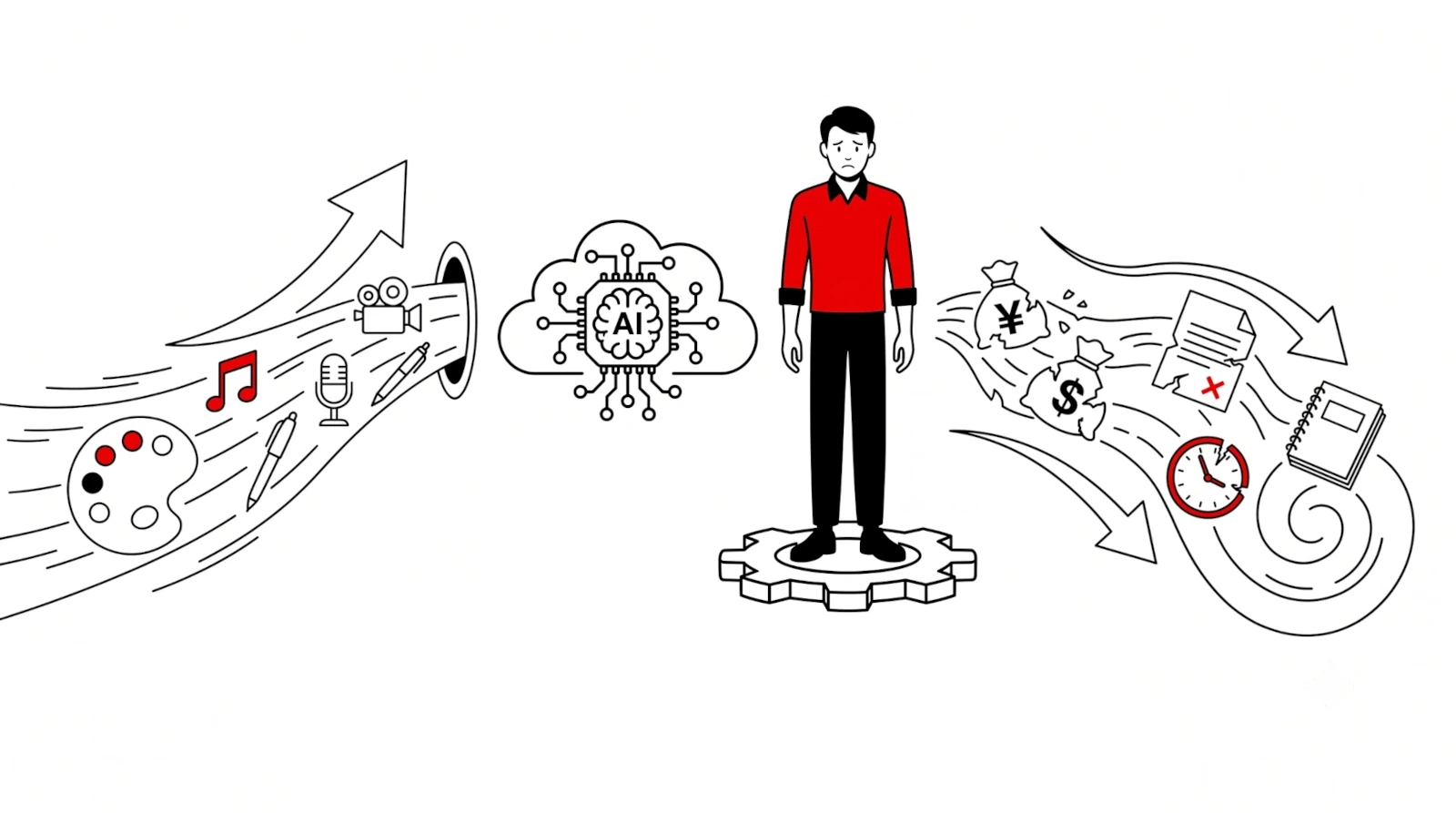
It has never been easier to generate images, text and sound. And it has never been harder to be paid for what you know how to do. Generative AI does not replace the artist — but it is being used to justify the precarization of creative work, supported by a market that lacks the repertoire to distinguish depth from surface.
The cheapening of creation as market policy
Platforms sell generative AI as “democratization of creativity”, but the real market effect is to compress the value paid for authorial work. The client compares your budget with the cost of three prompts and concludes the professional is too expensive — without realizing they are comparing a final result (the prompt) with an entire process (research, draft, error, redo, get it right).
Jensen, Murthy and Baker, in a study published in Information, Communication & Society, demonstrate that generative AI intensifies the precarity of creative labor by prioritizing hyper-efficiency over human work.[1] Erickson, researching six commercial AI products in the creative industry, found that human contributions were systematically invisibilized in final products — which foregrounded the AI as author while real human work remained hidden.[2]
What looks like “cheaper production” is actually cost transfer: work that was once paid as a service is now paid as a platform subscription, and the value that went to the professional goes to the infrastructure provider. Jiang and colleagues, in a paper published at the AAAI/ACM AIES conference, documented the direct economic damage caused by the proliferation of ML-based image generators — replacement of commissioned work, scraping of artists’ data without consent, and income compression in the creative sector, estimated at $48 billion.[3]
Pasteurized content is invisible to those without repertoire
The problem is not just economic. It is cultural. A significant portion of the public cannot distinguish AI-generated content from authorial content — and in some cases, prefers AI content.
Porter and Machery, in a study published in Scientific Reports with over a hundred citations, demonstrated that AI-generated poems are indistinguishable from human-written poems and, in blind evaluation, are rated more favorably than human ones.[4] The public not only fails to notice the difference — in certain contexts, they prefer machine-generated content. The market rewards what pleases, not what is deep.
Horton, White and Iyengar, in another study in the same journal with six experiments and nearly three thousand participants, showed that people devalue art labeled as AI even when they report it is indistinguishable from human art — but paradoxically, comparing the two side by side increases the perception of human creativity.[5] The problem is that comparison rarely happens in the real market: the client sees the final result, not the process.
This creates a vicious cycle: shallow content is consumed as if it were good because the average consumer has no reference point to evaluate it. Companies hire AI-generated content because it looks “good enough.” The professional who delivers depth loses the competition not due to inferior quality, but because the buyer cannot perceive the difference.
What art is, what process is
Art is not the final result. It is the path from idea to product: research, draft, error, redo, get it right. Generative AI delivers the result without the path. Prompt engineering is not creation — it is curation of output.
The prompt says what you want. The process says what you thought. A screenplay written by a human contains conscious decisions about narrative structure, pacing, subtext. A hand-drawn storyboard carries choices of framing, composition, art direction that an image generator did not make — it only simulated them from training data. An animator who defines the timing of a scene — how many frames between poses, what type of interpolation to use, where to stretch the motion for weight — is making decisions a model never made because it does not know what it is doing; it only calculates the most likely transition.
Bar-Gil, in a paper published in AI & Society, extends Walter Benjamin’s arguments about technical reproducibility into the digital age, describing AI-generated art as the result of “distributed agency” between the user typing the prompt, the model’s algorithmic mechanisms, and collective training datasets.[6] No one is the author of anything because no one controls the entire process.
The pseudo-individualization that Adorno identified in the culture industry finds its most advanced stage here: each generated image looks unique, personal, “made for you” — but it is generated from the same statistical model, the same dataset, the same standardized process any other user is using.[9] The appearance of originality is the product. Standardization is the process.
The artist as holder of the process
Those who master the complete pipeline — briefing, script, storyboard, animation, finishing — deliver something AI cannot: narrative coherence, aesthetic intention, conscious decision at every step. The prompt delivers not what you asked for, but what the model could generate from your request — and that, moreover, is biased. The process delivers what you thought.
The artist, in fact, is the one who participates in the entire process, from idea to final product. Not the one who pushes the button. Prompt users are not creating — they are selecting from variations they do not control. The difference is not in the result; it is in mastery of the journey.
Magni, Park and Chao, in four experiments published in the Journal of Business and Psychology, showed that there is a bias against artificial creativity — people tend to protect the perceived value of human work.[7] This phenomenon, called algorithm aversion, can act as a barrier against replacement, but the literature also documents the opposite — algorithm appreciation, when users prefer machine output because they believe it is more objective.[8] The bias is contextual, not absolute. And it only works if the buyer knows they are looking at AI-generated content. And, as we have seen, the average public cannot tell the difference.
What protects the artist is not bias against AI. It is the ability to educate the client to evaluate process, not just result.
What to do
Educate the client
The first step is to change the conversation from “how much does it cost” to “how is it done.” Showing the process — sketches, versions, decisions — documents the value that AI does not deliver. The client who sees the path understands why the result costs more.
Charge for knowledge, not execution
The professional’s value is not in pushing the software button, but in knowing which button to push, when, and why. Charging by the hour or by delivery is competing with AI. Charging for knowledge is competing where AI cannot reach.
Document the work as part of the value
The pipeline I documented in the post about my 100% free workflow is not just a technical account — it is proof that the process exists. Every verifiable step, every documented decision, every preserved source file is evidence that the result did not come from a prompt. This is what distinguishes industrial production from authorial work.
Frequently asked questions
Will AI replace artists?
Not replace, but redefine the market. Artists who master the complete process and can communicate their value to the client will differentiate themselves. Those who depend only on technical execution will compete with tools that do the same faster and cheaper.
How do I prove my work is more valuable than AI-generated content?
By documenting the process. Briefing, drafts, storyboard, direction decisions, revision versions — all of this shows there was thinking behind the result. The prompt leaves no trace. The process does.
Is AI-generated content always worse?
No. In some contexts, the public prefers AI content, as Porter and Machery demonstrated. The problem is not absolute quality — it is that the value of authorial work lies in the process, and the process is invisible to those who only see the result.
What if the client says “AI does it for free”?
Ask what exactly they want. If they want a generic image for an internal article, AI might suffice. If they want a campaign that communicates a specific message to a specific audience with visual and narrative coherence, only a professional who masters the process can deliver.
If you’re structuring an animation project, start with the Briefing Generator and the post about my 100% free production pipeline. For screenwriting, Fonte is available for free.
I produce animation with free software and documented processes. Get in touch if you’d like to discuss your project.
— Ricardo A. B. Graça · ricolandia.com
References
- Jensen, J. T.; Murthy, D.; Baker, S. (2025) Automating remix: generative AI, creative labor, and the decay of aura. Information, Communication & Society, 1-17. DOI: https://doi.org/10.1080/1369118x.2025.2609779
- Erickson, K. (2024) AI and work in the creative industries: digital continuity or discontinuity? Creative Industries Journal, 1-21. DOI: https://doi.org/10.1080/17510694.2024.2421135
- Jiang, H. H. et al. (2023) AI Art and its Impact on Artists. Proceedings of the 2023 AAAI/ACM Conference on AI, Ethics, and Society, 363-374. DOI: https://doi.org/10.1145/3600211.3604681
- Porter, B.; Machery, E. (2024) AI-generated poetry is indistinguishable from human-written poetry and is rated more favorably. Scientific Reports, 14(1). DOI: https://doi.org/10.1038/s41598-024-76900-1
- Horton Jr, C. B.; White, M. W.; Iyengar, S. S. (2023) Bias against AI art can enhance perceptions of human creativity. Scientific Reports, 13(1). DOI: https://doi.org/10.1038/s41598-023-45202-3
- Bar-Gil, O. (2025) The transformation of artistic creation: from Benjamin’s reproduction to AI generation. AI & Society. DOI: https://doi.org/10.1007/s00146-025-02432-5
- Magni, F.; Park, J.; Chao, M. M. (2023) Humans as Creativity Gatekeepers: Are We Biased Against AI Creativity? Journal of Business and Psychology, 39(3), 643-656. DOI: https://doi.org/10.1007/s10869-023-09910-x
- Dietvorst, B. J.; Simmons, J. P.; Massey, C. (2015) Algorithm aversion: people erroneously avoid algorithms after seeing them err. Journal of Experimental Psychology: General, 144(1), 114-126. DOI: https://doi.org/10.1037/xge0000033
- Horkheimer, M.; Adorno, T. W. (2002 [1947]) Dialectic of Enlightenment. Stanford: Stanford University Press.