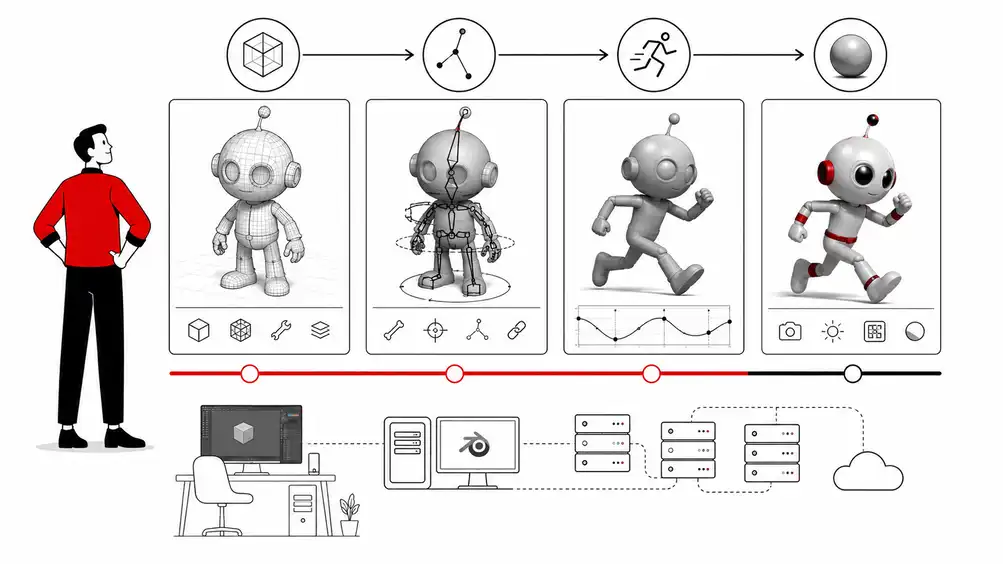
Pipeline is not just a sequence of steps. It’s a series of decisions accumulated over years, each one answering a real problem that appeared in a specific project. What I describe here is not the ideal pipeline — it’s mine, distilled from two decades of producing commercial and authorial animation exclusively with free tools.
Modeling
Everything starts in Blender, from sculpt or primitive to final mesh. I work with modifiers as a rule, not exception — Mirror, Subdivision Surface and Solidify solve the structure without destroying editability. Clean mesh is not aesthetics: it’s time saved in rigging and animation. A triangle in the wrong place costs dearly when the character needs to bend their knee.
Rigging
For characters, I use Rigify as a base and adapt. The ready system saves time on the standard bone structure; the adaptations are where the character starts to have mechanical personality. For objects and machinery, I prefer simple rigs with well-thought constraints — less bone, more control.
Animation
Blocking in stepped keys is where dramatic decisions happen: timing, weight, intention. Only after validating the blocking do I move to spline. Skipping this step is the most common mistake — you end up refining a performance that hasn’t been decided yet. The Graph Editor is where animation truly lives; understanding curves is not technical detail, it’s vocabulary.
Render
Cycles for projects that require materiality and light — advertising, short films, anything where photorealism matters. Eevee for previews, motion graphics and deliveries where speed is part of the equation. Distributed rendering across my local machines is part of the sovereignty pipeline: no farm queue, no cost per frame, no upload of proprietary assets to third-party servers.
A practical tip: keep a separate Blender file for material and lighting tests. This way you don’t clutter your production file with experiments, and you can reuse successful setups in future projects. This habit alone saves hours of work over the long run.
Blender also covers frame-by-frame drawing with Grease Pencil, which I use when a project calls for rotoscoping.
If you’re planning your next animation, check out the Production Time Calculator to estimate realistic deadlines for each pipeline stage.
The tool does not replace the creative decision. But a tool you fully control — whose code is available, whose community you can access, that won’t change policy in the middle of your project — frees the mental space for what matters.
— Ricardo A. B. Graça · ricolandia.com