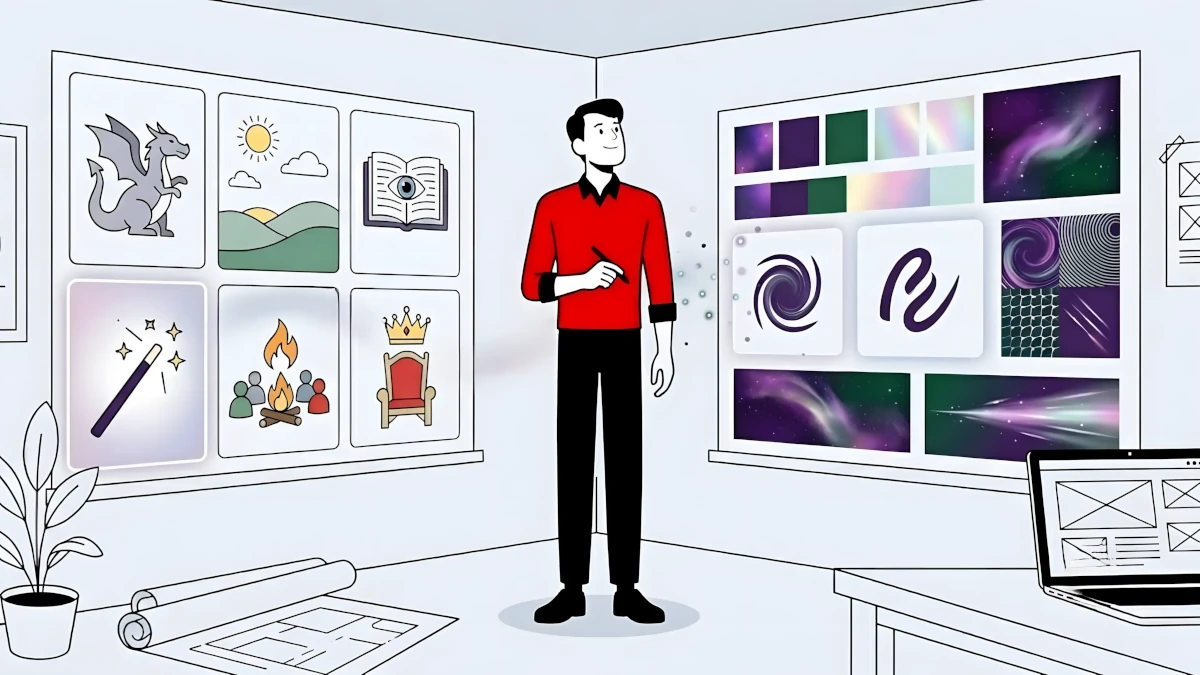
Before I choose a typeface, a color palette, or a transition speed, I need to understand who the brand is. And the fastest way to get there is to ask: what’s its archetype?
What Are Brand Archetypes
Carl Jung identified universal patterns of behavior present in the collective unconscious — archetypes. Margaret Mark and Carol Pearson adapted them for branding in The Hero and the Outlaw (2001), creating a map of 12 personalities that brands can inhabit.
This isn’t mysticism. It’s a briefing tool. When a client can say “we’re the Explorer,” half the art direction decisions are already made.
The 12 Archetypes and Their Visual Implications
| Archetype | Essence | Dominant color | Shape | Motion |
|---|---|---|---|---|
| Innocent | Purity, optimism | White, soft yellow | Organic, rounded | Light, floating |
| Explorer | Freedom, adventure | Earthy tones, moss green | Open, expansive | Dynamic, boundless |
| Sage | Knowledge, truth | Dark blue, gray | Geometric, precise | Slow, deliberate |
| Hero | Courage, achievement | Red, black | Angular, strong | Impact, acceleration |
| Outlaw | Rebellion, disruption | Black, intense red | Irregular, disruptive | Abrupt, sharp cuts |
| Magician | Transformation, vision | Purple, gold | Fluid, surreal | Metamorphosis, morphing |
| Regular Guy | Belonging, empathy | Neutral tones, mid blue | Simple, accessible | Natural, understated |
| Lover | Intimacy, desire | Deep red, rose | Curvilinear, sensual | Soft, slow, close |
| Jester | Joy, irreverence | Yellow, orange | Irregular, playful | Fast, bouncy |
| Caregiver | Protection, generosity | Green, light blue | Enveloping, warm | Gentle, welcoming |
| Creator | Innovation, expression | Varied, contrasting | Unique, authorial | Experimental, surprising |
| Ruler | Order, leadership | Navy blue, gold | Symmetrical, imposing | Controlled, majestic |
How I Use This in My Process
When I receive a brief, I ask three questions to help identify the archetype:
- Which brand do you admire? — The references clients bring usually reveal the archetype they want to inhabit, even unconsciously.
- What do you never want people to feel when they see your brand? — The answer typically points to the opposite archetype.
- If your brand were a person at a party, who would they be? — This question unlocks answers no creative brief form ever captures.
Once the archetype is defined, art direction has a clear north. It’s not a straitjacket — it’s a compass.
In Practice: Hero vs. Magician
Two clients in the tech sector, with completely different brand positions.
The Hero wants a product animation: high-impact motion, fast cuts, bold typography, red and black, a heavy soundtrack. The viewer needs to feel they can win with this tool.
The Magician wants the same product animation: fluid morphing, smooth transitions, a deep palette (purple, dark blue, gold accents), an ethereal soundtrack. The viewer needs to feel that something is about to transform.
Same product. Same format. Completely different art directions — because the archetypes are different.
Archetypes Aren’t Fixed Labels
A brand can move between archetypes over time, or combine two archetypes in productive tension. Apple is simultaneously Creator and Outlaw. Nubank started as an Outlaw and now navigates between Hero and Regular Guy.
What matters is that the art direction reflects the brand’s communicative intention at that moment — and that visual choices are conscious, not arbitrary.
Knowing the archetypes is what separates an animator who executes from an art director who leads.
I work with art direction and animation using 100% free and open source tools. Get in touch if you want to talk about the visual positioning of your next project.
— Ricardo A. B. Graça · ricolandia.com