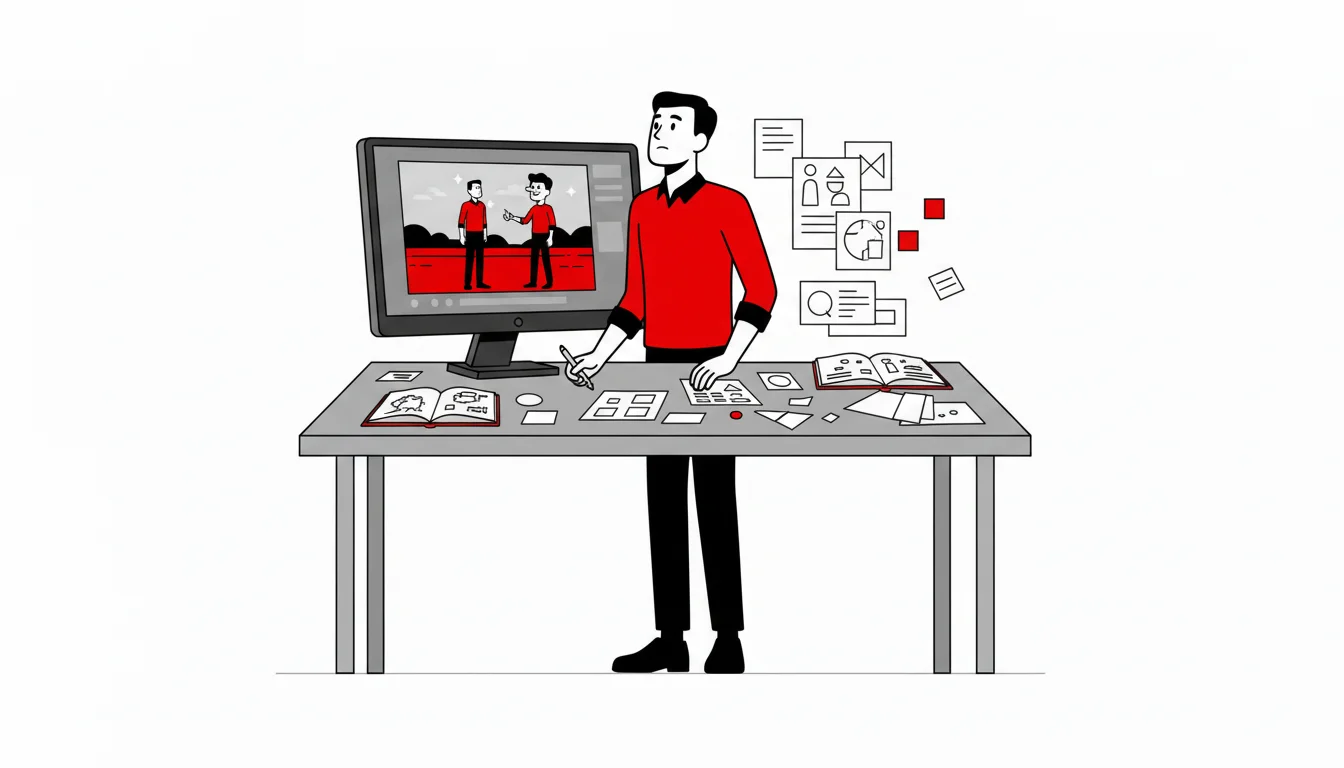
Every frame you see on screen began with research, notes on paper or in applications like Trilium (which also has an Excalidraw canvas). People see the result, but almost nobody sees the process. And it is precisely the process that explains why an animation works or doesn’t. I will show you mine: what goes in and what gets left out.
The start: the question (not the idea)
I don’t start by executing an idea. Anyone can have a loose idea, and that is why so many projects start well and get stuck halfway. I start with a question that bothers me.
Caminho das Alturas was born that way: not from an idea for a scene, but from a question about a real story almost nobody was telling. The difference matters: an idea asks for execution; a question asks for investigation. And investigation sustains months of work, while a loose idea does not.[2]
Research and references: filling the notebook with notes
The stage most people skip, and the one that changes the result the most.
I research in books, academic papers, image banks, and not only visually: I read, clip, jot down loose phrases, collect images I don’t yet know where to use. In the short film, that meant rebuilding part of the real sets, climbing gear, light, vocabulary. None of it shows up as “research” on screen. It shows up as shot and scene.
This is where semiotics enters in practice: learning to read images before producing them.[1] When I understand why a framing means what it means, I stop choosing by taste and start choosing by meaning — I wrote about this in semiotics and image construction.
There is a difference I take seriously: reference is not copying. Copying is taking someone else’s finished solution and pasting it. Referencing is understanding the mechanism behind the solution and applying it to your problem. The first produces generic work; the second produces language. My criterion: if I can explain why that reference works, I can use it. If I just like it, I haven’t understood it yet.
Direction decisions: every choice has a reason
When the research material is on the table, direction begins. And direction, in my process, is a sequence of decisions that need justification, not personal taste.
Shot, color, scene timing and sound are the levers. Color defines mood before any dialogue; timing suggests where the viewer breathes; sound, including silence, suggests what they feel. In tense scenes, the right decision is often not to show: off-frame communicates more than any animation one could draw there.
With every choice, I ask the same question: what is this saying?
From drawing to frame — and what gets left out
The part everyone shows is the before and after. The middle is more interesting.
I sketch, discard, sketch again. A short film of a few minutes carries weeks of material nobody sees: scenes cut in editing, characters that didn’t work, narrative paths abandoned. The cutting criterion is simple: if the scene doesn’t change what comes next, it goes. The process is made of subtraction, and accepting that separates authored work from serial production.
If you want to see how this method lands in a concrete result, I wrote about what an award-winning short film teaches about communication; and when a scene calls for drawing over real reference, rotoscoping comes in.
What sustains this stage is the free pipeline: the tools don’t change halfway, files remain accessible, and every decision can be revisited years later. It holds for animation as for any creative project. The process needs to survive the project itself.
Documenting the process
I document everything: notebook, file, notes, git (which is very interesting for the writing side). Not out of vanity, out of method.
Documentation forces me to think before acting: writing the decision down is harder than making it. Then it becomes work memory: months later, I know why I chose that framing. And it builds trust with clients: someone who sees the process trusts the result more.
That logic is what led me to build Fonte, with a cultural project module included: documentation is part of the craft.
FAQ
Where does an animation begin?
It begins with a question that bothers you. The question defines the research, the research defines the script, and the script defines the animation, in that order.
How does research become imagery?
Research becomes visual vocabulary: a repertoire of shapes, colors, light and references that informs every direction decision. Semiotics enters to turn that repertoire into choices with meaning.
How long does a short film take?
In my process, between research, script, animation and editing, a short film takes years. Time varies with scope — but distrust deadlines that don’t include research: it is the stage that sustains all the others.
How do you document the creative process?
In my case: nowadays, on the street, I jot in a rough notebook, with pencil or pen; in front of the computer, the record goes straight into Trilium, with day-to-day decisions and production files organized by stage. What matters is that it happens during the project: done afterwards, it is only reconstruction.
What do you do when a scene fails?
First, understand what it was supposed to say. If the answer is confusing, the problem is in the direction decision behind it. Often the solution is to cut: removing usually works better than adding. One observation: storyboards help a lot, but it is only in the final edit — with voices and sounds — that we can decide how the piece will finally be.
References
- Barthes, R. (1964). Rhétorique de l’image. Communications, 4, 40–51. DOI: 10.3406/comm.1964.1027. (The image is polysemic; the text anchors one of its meanings — the basis of image reading applied to direction.)
- Own experience — documented process of the short film “Caminho das Alturas” and authorial projects, with notebooks, boards and production files.
If your project needs direction with method, get in touch.
— Ricardo A. B. Graça · ricolandia.com