There’s a difference between an animator who knows how to make things move and an animator who knows what those movements mean. Semiotics is the discipline that handles this second layer — and ignoring it means giving up one of the most powerful tools in visual communication.
You don’t need a philosophy degree. The core concepts fit in one post, and the practical application is immediate.
What is Semiotics?
Semiotics is the study of signs — everything that stands for something else and generates meaning. Developed independently by Charles Sanders Peirce and Ferdinand de Saussure in the late 19th century, it offers a vocabulary for understanding how images, colors, shapes, sounds, and movements produce significance.
For those working with animation and motion graphics, Peirce is the more useful of the two. He doesn’t treat language merely as a verbal system, but as any process of representation — which includes everything that appears on screen.
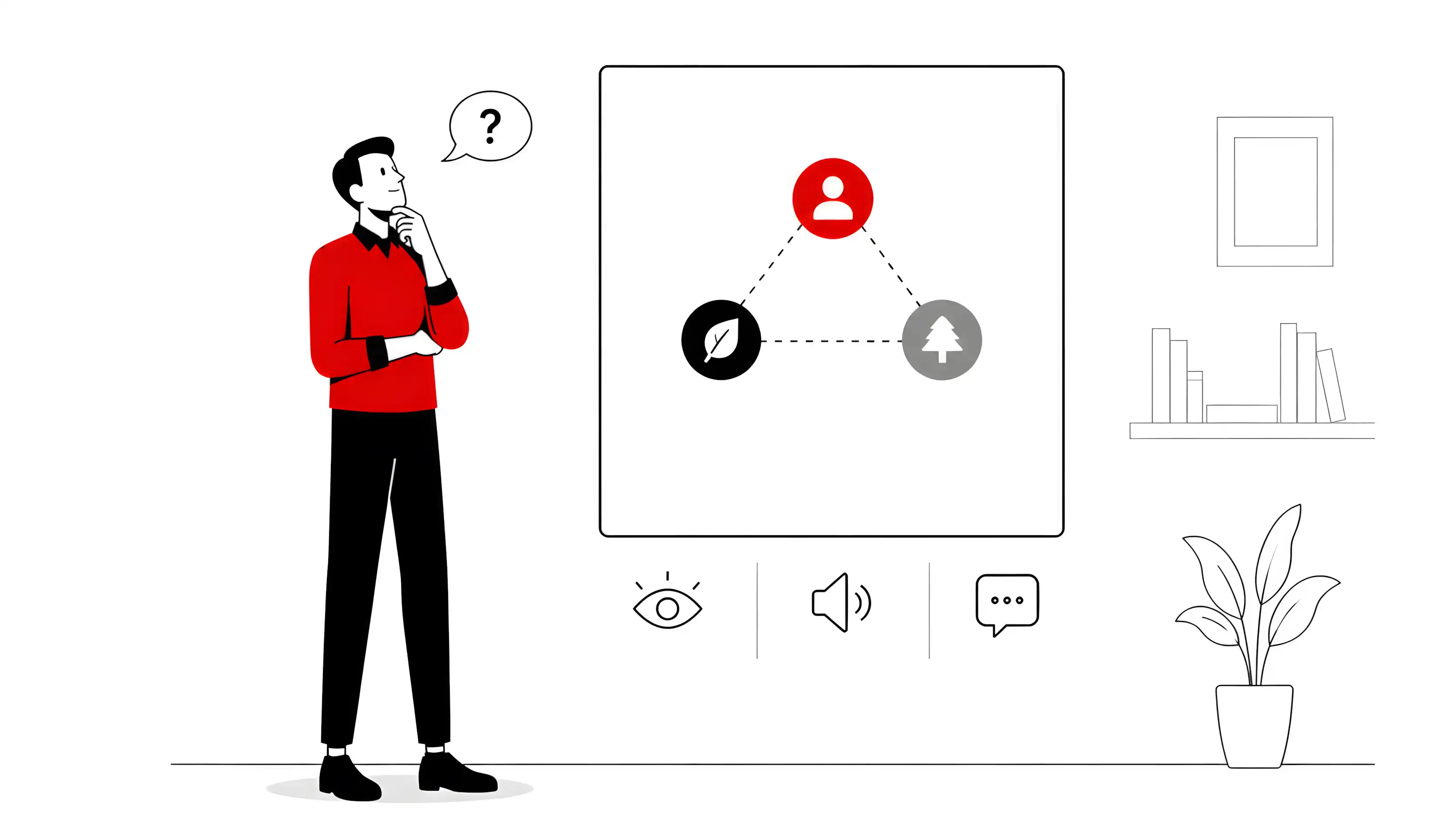
Peirce’s Three Categories
Peirce organized human experience into three categories that he called phenomenology. They describe how we perceive and attribute meaning to anything — including an animated scene.
Firstness
The immediate, spontaneous perception, before any analysis. It’s the raw sensation of seeing something for the first time, without yet naming or interpreting it.
In animation: it’s the impact of the first few frames. The background color, the speed of the first transition, the visual weight of elements. The viewer doesn’t yet know what they’re seeing — but they’ve already felt something. That feeling will color everything that follows.
Secondness
The reaction, the confrontation, the interpretation. This is when perception meets reality and produces meaning: “that’s a gear icon, so we’re talking about technology.”
In animation: it’s the moment when the viewer begins to read the scene — identifying characters, understanding context, associating elements with concepts. This is where more rational design choices come in: shape, typography, iconography.
Thirdness
The mediation through accumulated experience. It’s the cultural and symbolic meaning we build from previous experiences — conventions, archetypes, shared references.
In animation: it’s when a character dressed in white evokes purity without saying a word, or when a color progression from gray to gold communicates transformation before the narration confirms it. These are the layers of meaning that work for those who share your same cultural repertoire.
The Three Levels of Image Comprehension
Beyond the categories, Peirce gives us a way to analyze any image on three levels:
1. Signified — what arises in the mind at first glance. Colors, lines, shapes, volume, light, movement. It’s immediate and pre-verbal.
2. Referent — the context in which the element is placed, its identity traits. A circle in isolation is a shape; a circle with an apple inside it is the logo of a specific company.
3. Signifier — the cultural and symbolic associations activated. Green and yellow evoke Brazil for a Brazilian; the same green might evoke something else for another audience.
These three levels operate simultaneously in every frame you produce.
Why This Matters in Practice
When you animate a character solving a problem, you’re not just moving pixels. You’re building a visual argument with layers of meaning operating in parallel:
- Color has already communicated the emotional tone (firstness)
- Character design has already told who that story is for (secondness)
- Narrative structure has activated cultural patterns that the viewer recognizes unconsciously (thirdness)
An animator who ignores these layers produces videos that “feel okay” but don’t convince, or that “feel wrong” without anyone being able to say exactly why. Semiotics gives you the vocabulary to diagnose those problems before delivery.
One Question for Each Project
Before finalizing any animation, I ask three questions inspired by Peirce’s categories:
- What is the first sensation? — If someone pauses on the first frame, what will they feel before they think?
- Is the context clear? — Do the visual elements communicate the correct universe of the brand or topic?
- What cultural associations am I activating? — Are these associations what the client needs? Do they make sense for the target audience?
Three questions. Applicable to any scene, any style, any format.
Semiotics is Not Theory for Theory’s Sake
It’s common to treat semiotics as an academic subject. But in practice, it’s a tool for visual diagnosis. Animators, art directors, and motion designers who know it make more conscious decisions — and can defend those decisions to clients with much greater precision. See semiotics in practice: how the image speaks before the script with applied examples.
When a client says “I don’t know, it feels like something’s missing” and you can answer “the problem is in secondness — the visual elements aren’t communicating the brand’s correct context” — the conversation moves to a different level.
I produce animation and motion graphics with attention to every layer of meaning, from the first frame to the final cut. Contact me if you’d like to talk about your project.
— Ricardo A. B. Graça · ricolandia.com