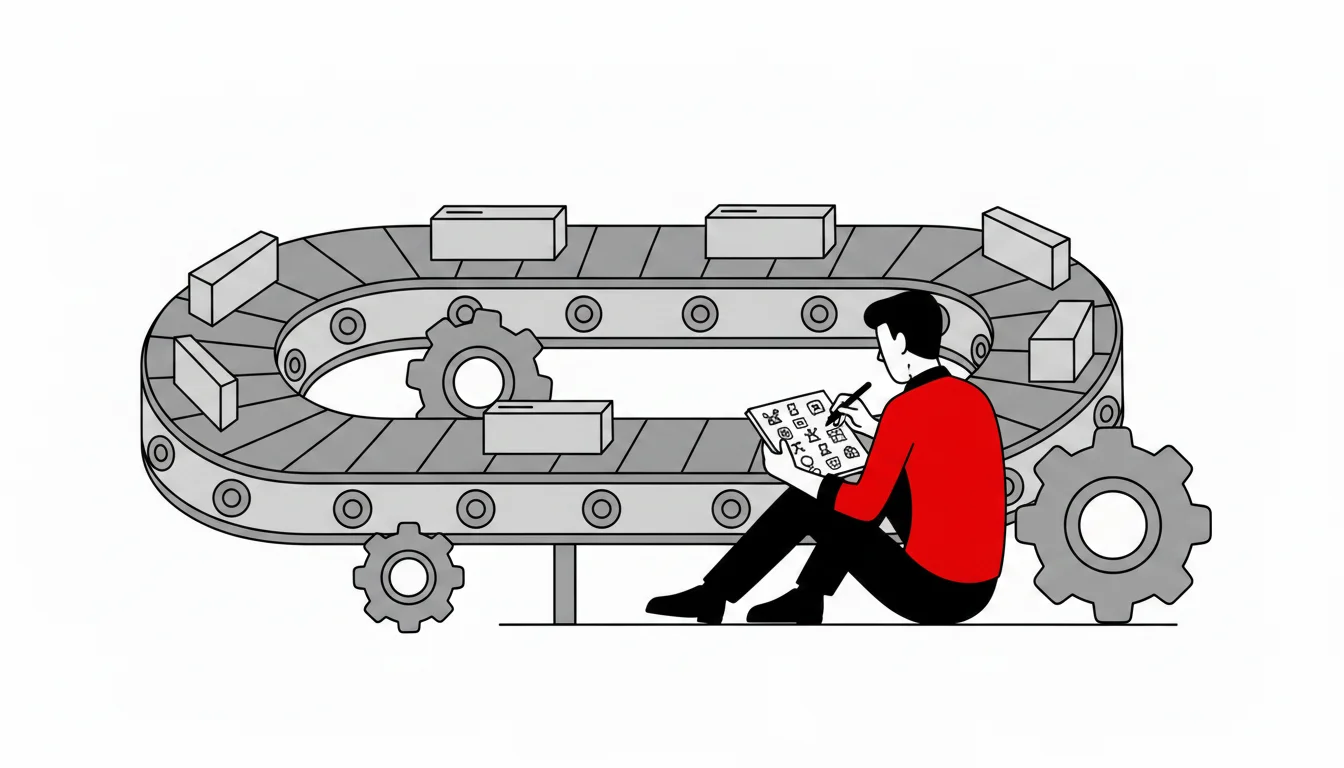
The shallow content machine is not an accident. It is a production line — and for the artist standing in the middle of it, there are two choices: get on the belt, or draw outside it. I have already written about the industrial design of platforms and about the viewer’s role in this cycle. Which leaves the question that drives me: what does the artist do when the system wants the artist to produce for the algorithm?
The shallow content machine, briefly
I won’t repeat the whole argument — it lives in the two previous posts of this series: the shallow content machine and the viewer as part of the problem. The thesis in short: video platforms are assembly lines optimized for retention, not for understanding. What rises is what grips without effort, and depth is systematically penalized.
What I want to do here is different. I want to talk about the artist — about those who make work inside this system — and what it means to resist it.
The artist’s role (the core)
For the artist, resistance is not being against technology. It is being against the logic of the belt — against the idea that the value of work is measured by the production pace the platform imposes.
The belt wants volume. It wants consistency — and it wants each piece to resemble the previous one, with small, statistically validated variations: what Adorno and Horkheimer called pseudo-individualization, products that look unique but all follow the same template.[1] The belt doesn’t ask you to think. It asks you to deliver.
The artist who resists does the opposite: chooses their own pace, their own measure of success. That sounds romantic and is, in practice, a production decision — perhaps the most unpopular one in today’s market, because it clashes with the editorial agenda everyone repeats: “post every day, or the algorithm forgets you.”
I publish when I have something worth publishing. My short films take years — and that is exactly why they exist.
In practice: what I do
Resistance is not theory in my case. They are concrete choices I have kept for over twenty years:
Research before the script. I don’t write “from memory”, I write from what I investigated. In the award-winning short, the process began with historical research on a 1933 female climber — the narrative was born from an archive, not from a data-validated narrative pattern.[2]
A free pipeline. My entire process — script, storyboard, animation, render — runs on free software and self-hosted infrastructure. It’s not a banner I wave: it’s that the proprietary tool’s belt is just another version of the same belt. When I control the pipeline, I control the pace.[3]
Patience with process. Belt content has a shelf life of hours. What I make has a shelf life of years — and it keeps working, accumulating, working in my favor instead of demanding constant production.
Resistance is not passive
Resisting the belt has a simple name: keeping on producing art that doesn’t need it to exist — and that changes where it lives, how it is funded, and who reaches it.
Art that only exists inside algorithmic logic dies when the algorithm changes. Art with roots — community, craft, method, historical context — endures. It is the difference between a piece that is a product of a system and one that is the expression of a life of work.
There is also the honest counterexample: it is possible to do authored work inside the platforms, and some do it very well, with long, dense video essays that work. The variable, as I wrote before, is density of reward per minute, not duration.
But the format tactic only solves the problem up to a point. The ceiling of what the belt accepts is limited, and the artist needs to know where that ceiling is, so they don’t spend their life underneath it.
FAQ
What is the shallow content machine?
It is the content production system optimized for attention retention: platforms, algorithms and metrics that reward what grips without effort and penalize depth. I wrote the full analysis in The Shallow Content Machine.
Is the artist against the algorithm?
Against the logic of the belt, not against technology. The algorithm is a distribution medium; the problem is when it becomes the criterion for composition. The difference between using the belt and being used by it is the point.
How do you resist without leaving the market?
Resistance isn’t abandoning distribution — it’s not letting it determine the work. Publish when there is something to say, keep process and research ahead of production, and understand that consistency of craft matters more than constancy of posting.
Does this apply to corporate video?
Partly. Corporate clients don’t ask for art — they ask for communication that works. But the same principle applies: video made with method, research and clear direction performs better than industrial “more of the same”. It is what I argue in my free pipeline and in my services.
References
- Horkheimer, M.; Adorno, T. W. (1985 [1947]) Dialectic of Enlightenment. (The concept of pseudo-individualization in the culture industry.)
Notes
- Own experience — the research process behind the award-winning short, documented in What an Award-Winning Short Film Teaches About Communication.
- Own experience — pipeline documented in My 100% Free Pipeline.
If your project asks for an artist’s eye — and method — get in touch.
— Ricardo A. B. Graça · ricolandia.com