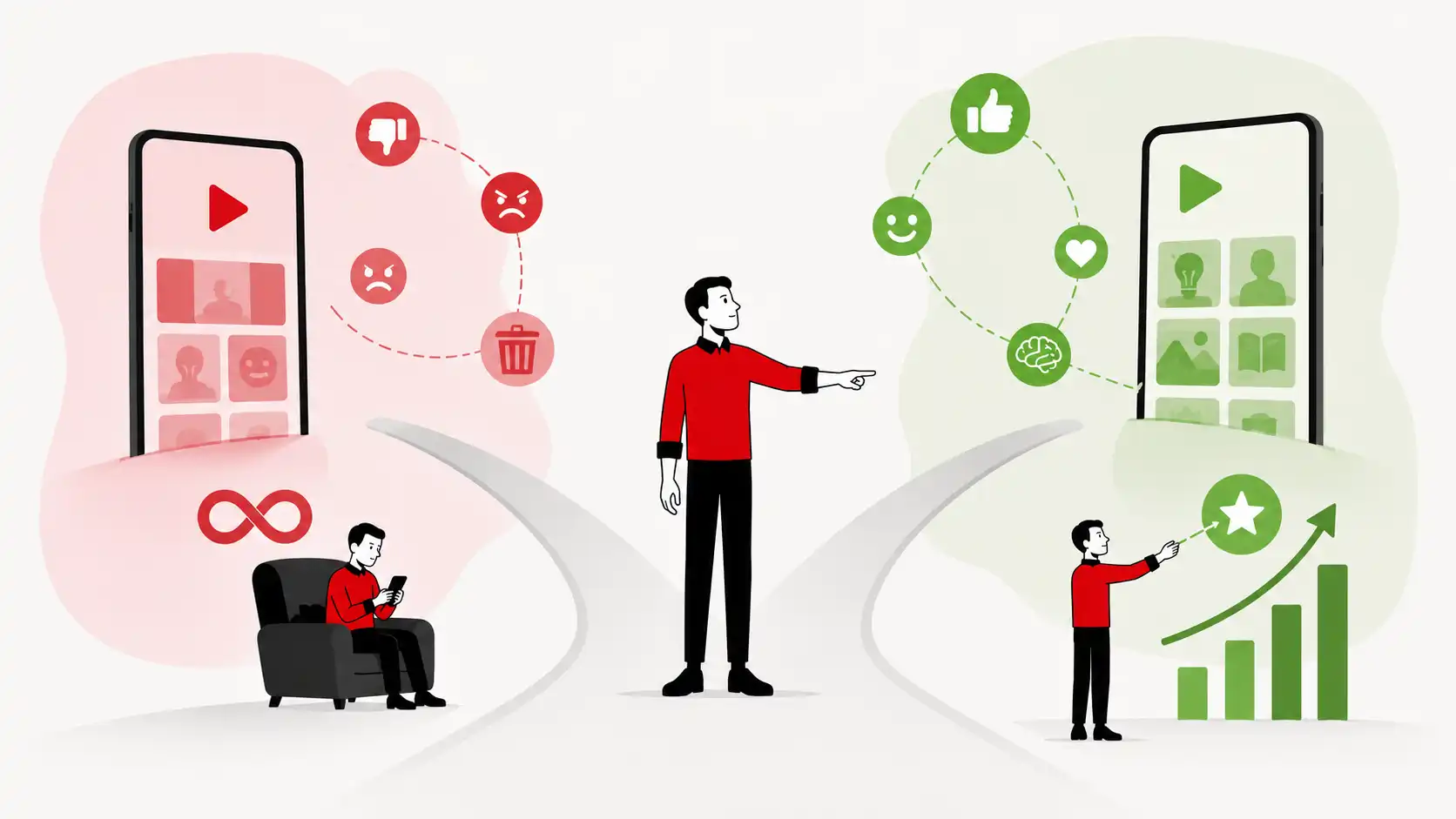
The algorithm doesn’t produce shallow content alone. The industrial machine I described in the previous post about the shallow content machine exists, yes — but it only runs because there’s demand on the other side. The viewer who consumes without choosing, scrolls without reading, shares without verifying is the other half of the equation. And can also be the solution.
Blaming the algorithm entirely is comfortable, but incomplete. The algorithm optimizes for what the user does — not for what they say they want. And what the user does, on average, is passively consume what demands the least. The problem isn’t just supply: it’s demand.
The viewer was trained for passivity
Neil Postman, in Amusing Ourselves to Death, described back in 1985 how television reconfigured information consumption habits — not through its content, but through its form. A TV newscast interrupted by commercials, theme music and quick cuts cannot sustain complex thought, because the medium wasn’t designed for it. The viewer learned to expect entertainment even when receiving information.[1]
The difference is that the algorithmic feed took this logic to its extreme. On TV, the passive viewer at least had a fixed schedule — what aired, aired, and they decided whether to watch or not. In the feed, there is no schedule. There is a continuous, personalized stream that adapts in real-time to the slightest signal of engagement or disengagement. The viewer no longer chooses what to see — they merely react, and the system learns to keep the reaction going.
Herbert Simon described the structural problem in 1971: when information is abundant, what becomes scarce is the attention available to process it.[2] The consequence Simon didn’t predict is that systems optimized to compete for scarce attention don’t just organize information differently — they shape the user’s very habit of attention. The viewer spending hours on the feed isn’t just consuming information: they’re being trained to consume information in a specific way — fast, shallow, reactive.
Your cognitive surplus — you decide how to use it
Clay Shirky, in Cognitive Surplus, argues that humanity’s free time, combined with digital collaboration tools, creates a cognitive surplus that can be used to create civic value — or to consume passively. Technology amplifies the choice, but doesn’t determine it. LOLcats and Wikipedia come from the same surplus. The difference is how you use it.[3]
This isn’t moralism against entertainment. It’s recognizing that passive and active consumption are different choices, and the average viewer rarely makes them consciously. Infinite scroll isn’t a renewed decision with each new video — it’s an autopilot state where the decision has been delegated to the system. Shirky draws attention to something simple and profound: most of the world’s cognitive surplus is still spent on passive consumption, not because there are no alternatives, but because passivity is the path of least resistance.
The question viewers should ask themselves isn’t “did the algorithm trap me?” but “did I choose to be here?”
The viewer as co-producer of shallowness
Valkenburg, Peter and Walther, in a comprehensive review of media effects published in the Annual Review of Psychology, show that audiences are not passive in the reception process — they select, interpret and respond to content based on their own experiences, motivations and prior interests.[4] This means viewers actively participate in creating the cycle that produces shallow content.
If viewers consistently click on immediate-reaction content — outrage, shock, disposable entertainment — the system interprets this as a quality signal and produces more of the same. If they consistently skip dense content, the system interprets this as a signal that density is not desired. The algorithm doesn’t “know” what’s good or bad — it only knows what retains. And what retains is largely determined by the aggregated behavior of viewers.
This isn’t the individual viewer’s fault. No one consciously decides to impoverish the content ecosystem. But the aggregate effect of billions of small individual choices — skip, ignore, scroll past — creates a structural bias against depth. The system simply reflects, at scale, what most people do on autopilot.
What viewers can do
1. Pause before reacting
The first step isn’t technical, it’s behavioral. Before sharing, liking or commenting, ask: did I actually process this? Or is it just a conditioned reflex? A one-second pause between stimulus and response already interrupts the reactive consumption cycle.
2. Diversify your media diet
Just as a monotonous food diet produces nutritional deficiencies, a media diet based solely on algorithmic feeds produces cognitive deficiencies. Seeking content from sources not optimized for retention — books, newsletters, long-form documentaries, written essays — is an act of resistance that exercises other modes of attention.
3. Consume as if you were to produce
The most powerful question a viewer can ask while watching any content is: “what would I do differently?” This posture — consuming with the critical eye of a producer — transforms passive consumption into active learning. You don’t need to be a professional content creator to benefit from this shift. Just watch as if you were going to analyze it, not just to pass the time.
None of these actions solve the algorithm problem. But they rebuild, in the viewer, the capacity for choice that the system tries to erode. And without viewers who choose, no structural solution — alternative platform, different business model, regulation — will be enough.
Frequently asked questions
Is the viewer actually to blame for shallow content?
Blame isn’t the right word — responsibility is better. Every click, every share, every second of attention signals to the system what should be produced at greater scale. The viewer doesn’t create the algorithm, but feeds it behavioral data that the algorithm uses to decide what to promote.
Does changing my own consumption habits make a difference?
Individually, almost none. But viewer behavior is aggregated. If a critical mass of people changes consumption patterns, the system responds. The growth of platforms like Nebula shows the market also responds to demand for quality.
Is consuming entertainment wrong?
No. Entertainment isn’t the problem. The problem is when entertainment becomes the only available mode of consumption — when all content is flattened to fit the same stimulus-response mold. The issue is whether you have a real choice about how to consume.
What do alternative platforms have to do with this?
Platforms like Nebula, PeerTube and direct subscriptions decouple creator revenue from ad retention. But they only work if viewers choose to switch. The structural solution depends on viewer choice.
If you’re structuring a content project, use the Briefing Generator and Content Planner — tools I created to help think through content before producing it. And to find the right tone for your communication, the Voice Tone Checker helps align your message.
I produce content that respects the viewer’s attention. Get in touch if you’d like to discuss your project.
— Ricardo A. B. Graça · ricolandia.com
References
- Postman, N. (1985) Amusing Ourselves to Death: Public Discourse in the Age of Show Business. Viking Penguin.
- Simon, H. A. (1971) Designing Organizations for an Information-Rich World. In: Greenberger, M. (ed.). Computers, Communications, and the Public Interest. Johns Hopkins University Press.
- Shirky, C. (2010) Cognitive Surplus: How Technology Makes Consumers into Collaborators. Penguin.
- Valkenburg, P. M.; Peter, J.; Walther, J. B. (2016) Media Effects: Theory and Research. Annual Review of Psychology, 67, 315-338. DOI: https://doi.org/10.1146/annurev-psych-122414-033608