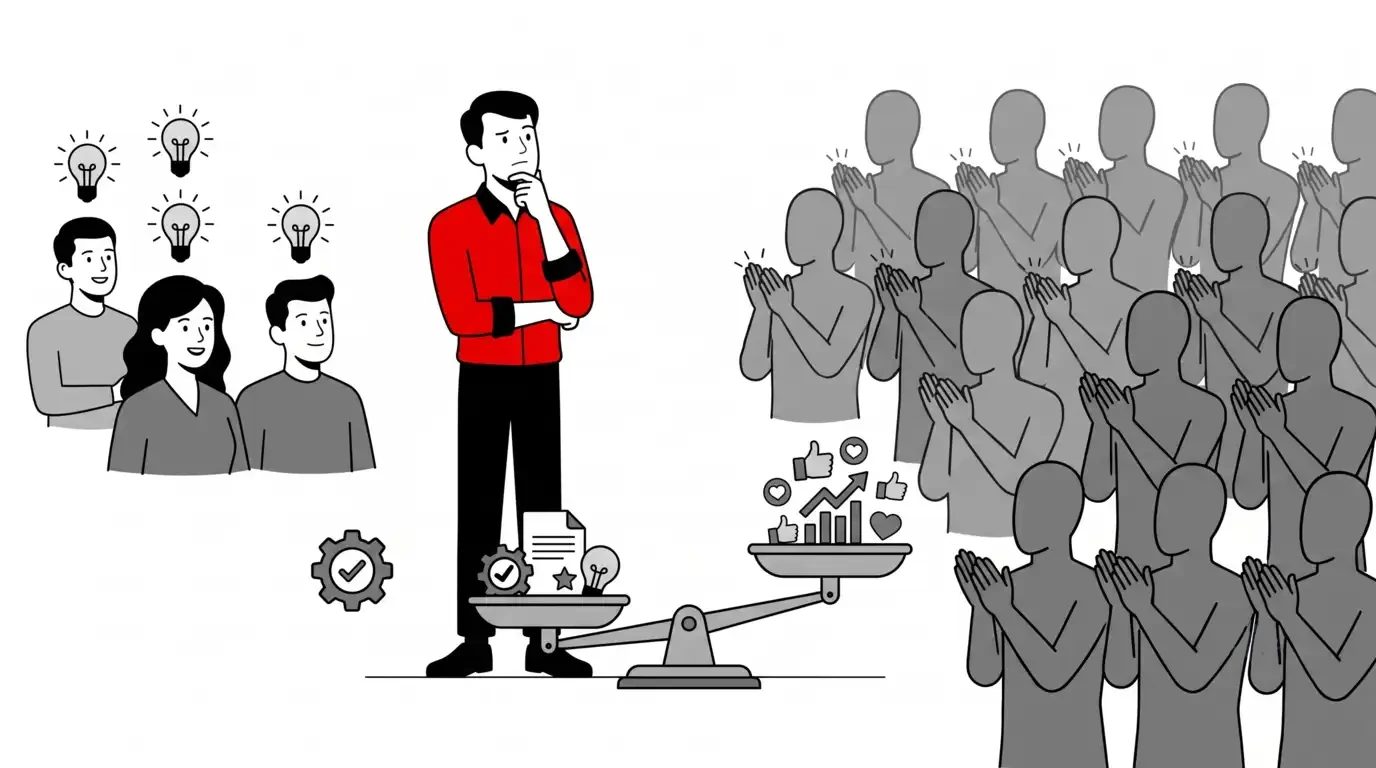
If you produce social media content and feel that the more engagement you get, the less your message is understood — it’s not your imagination. The system was designed for this, and cultural critics have been pointing it out for decades.
What goes viral rarely convinces. And what convinces rarely goes viral. The right question isn’t “how many views” — it’s “did those who watched understand?”
The problem: engagement is not communication
The algorithm rewards behavior: save, share, comment, watch until the end. None of these metrics measure whether the message was understood. A video that triggers anger, outrage or shock can rack up high engagement without communicating anything of value — or worse, communicating the wrong thing.
This confusion between captured attention and transmitted information isn’t new, nor is it exclusive to social media. In 1971, economist Herbert Simon already described the structural problem of any information-saturated environment: when information is abundant, what becomes scarce is the attention available to process it — and systems designed to deliver more information, without relevance filters, worsen the problem instead of solving it.[1] Half a century later, the logic of video platforms is exactly that: deliver more, faster, more often — without “more” meaning “better understood.”
The problem isn’t video duration. It’s whether the viewer learned anything — and that question has no answer in any platform’s analytics dashboard.
Shallow content for a shallow common sense
There’s an inversion happening, and it’s more troubling than it first appears. It’s not just that quality content loses space to engaging content — that would be serious enough. It’s that this loss has a direction: knowledge produced with rigor, verification and maturation time is being pushed to the margins, while common sense — increasingly impatient, increasingly unwilling to sustain a complex idea for more than a few seconds — gets used to demanding less and less from those who produce content for it.
This is a self-reinforcing cycle, and research on algorithmic culture has a name for the mechanism behind it. Tarleton Gillespie describes recommendation and curation algorithms as a new form of gatekeeping: unlike the human editor, who decided what was relevant through explicit judgment, the algorithm decides based on accumulated engagement signals — and naturalizes this decision as if it were neutral, technical, without a point of view.[2] Ted Striphas calls this shift “algorithmic culture”: symbolic curation, historically done by critics, editors and human curators, is progressively delegated to computational processes optimized for scale, not value.[3] What rises isn’t what’s truest or best argued. It’s what performs best within the logic the system rewards.
The depreciation of academic content is a symptom of this, not a cause. Research, verified data, bibliographic references, step-by-step arguments — all of this loses competitiveness in an environment where the success metric is immediate reaction, not understanding. The result is an audience that grows increasingly suspicious of those who cite sources and increasingly trusting of those who assert with conviction. Form defeats content. Performed certainty defeats honest complexity.
And there’s an uncomfortable empirical finding in this story: even within the logic of the click itself, shallowness doesn’t always deliver what it promises. A study published at CHI, the leading human-computer interaction conference, tested headlines classified as clickbait — including the list format, like “5 tips for…” — against non-sensationalist headlines covering the same news. The result: clickbait generated no more curiosity or real engagement than direct content.[4] Shallowness doesn’t always win because it works better. Sometimes it wins because it’s cheaper to produce, and the industry has learned to tolerate this loss of effectiveness in exchange for volume.
Quality content is authorial work
Here’s the point that separates communication from digital marketing: nearly all marketing content today is produced from a formula. Hook structure in the first three seconds, list promise, cut every two seconds, repeated CTA — a pattern replicable by anyone, any brand, any generative AI tool, because it requires nothing more than following instructions validated by aggregated data. This isn’t communication. It’s industrial content production wearing a mask of spontaneity.
Theodor Adorno and Max Horkheimer described this mechanism decades before the internet existed, analyzing what they called the culture industry: standardized cultural products that present themselves as individual when in fact they follow a scheme — what the authors term “pseudo-individualization.”[5] Today’s digital marketing content is this same logic pushed to its technical limit: each video feels personal, authentic, “made just for you” — but it’s generated from the same statistically validated script any competitor is also using. The appearance of originality is the product; standardization is the process.
What still resists this standardization is authorial work: a point of view that can’t be generated by formula because it comes from real experience, specific reasoning, an aesthetic choice that takes risks. Walter Benjamin called “aura” what is lost when a work is reproduced at scale — the mark of a unique, unrepeatable origin.[6] Shallow marketing content has no aura because it has no origin: it’s reproduction of a pattern, not expression of an author. Producing with quality today is essentially this: reintroducing authorship where the industry only wants formula.
Using the algorithm against the algorithm
This doesn’t mean refusing the algorithm — that would be strategic naivety in 2026. It means understanding exactly what it measures and what it doesn’t. The algorithm doesn’t demand shallowness; it demands retention, duration, response. Nothing in this prevents a dense, well-structured, authorial video from performing well — it only prevents it from performing well by accident, the way formulaic content does.
The strategic shift is to treat the algorithm as a distribution channel, not a composition criterion. Produce thinking first about the idea and the person who needs to receive it, and only then ask how to structure it so the distribution system doesn’t sabotage the message — cuts in the right place, a hook that isn’t empty, rhythm that sustains attention without emptying content. It’s the opposite of optimizing for the algorithm from the very conception of the idea. It’s making the algorithm carry an idea it wouldn’t have produced on its own.
The right audience vs. the big audience
A hundred views from people who understand your product, remember your message and might hire you are worth more than 10,000 views that scrolled past. This isn’t a defense of “niche video” — it’s a cost-benefit observation. Producing a video takes time, money and creative energy. If the return is empty visibility, the investment was wasted.
I’m not talking about technical quality — 4K resolution, expensive cameras, gimbals. I’m talking about quality of thinking: does the video show someone actually thought about this, or is it just another piece coming off the same assembly line everyone else is using?
Less engagement isn’t less value
Quality content continues to contribute to reflection and growth even when it engages little. The value of an idea isn’t measured by how fast it spreads — it’s measured by what it changes in those who truly absorb it.
A video that makes a hundred people think differently about a problem did more than a video that made a hundred thousand people scroll their feed for three seconds and forget the next minute. This doesn’t show up in any metric. There’s no line in the algorithm’s report for “person who changed their mind” or “person who came back to think about this a month later.” But it’s the only kind of impact that’s truly worth the effort of producing.
This requires an act of resistance from the producer: continuing to prioritize depth knowing that immediate returns will be smaller. Not out of naivety about the market, but out of understanding that there’s a difference between reach and permanence. Shallow content disappears with the next scroll. Content that demands something from the viewer — attention, reasoning, time — is what stays.
The algorithm is not your client
Your client is the person on the other side of the screen. The algorithm is just the medium. Producing for the algorithm is like writing an article to rank on Google instead of writing for the reader: it works in the short term, but builds nothing.
Videos that truly communicate generate a type of engagement that doesn’t show up on the dashboard: the viewer who watches, understands, remembers, and when they need your service, comes back. That’s not viral. That’s sustainable — and it’s authorial work, not assembly-line product.
Frequently asked questions
Does quality content actually get less reach?
Sometimes, in the short term. But the reach you lose in quantity you gain in depth. One person who understood your video is worth more than ten who scrolled past. The problem is when we give up on depth before giving it time to find its audience — mistaking propagation speed for real impact. Content that demands reasoning doesn’t go viral in the first hour, but builds a kind of authority shallow content never reaches.
How do I measure if viewers understood?
There’s no dashboard metric for comprehension. What exist are indirect signals: comments with specific questions, direct messages citing your argument, leads who mention your video as the reason they reached out. These indicators don’t appear in any automated report — they require you to read what people are saying, not just count how many passed through the funnel. It’s artisanal listening work that no platform automates because it doesn’t generate sellable data.
Is authorial content worth producing for social media?
Yes, if you understand the game isn’t the viral moment, but building a position no competitor can replicate because it comes from real experience. Authorial content has higher production costs, slower returns, and can’t be generated by AI — precisely why it’s the only type that builds long-term differentiation. The problem is that the digital marketing industry doesn’t teach this, because it can’t be scaled.
Why produce with free software
Producing quality content doesn’t depend on expensive tools — it depends on planning, clarity and respect for the viewer. The same questions I use to structure a social media video are the ones I use for any project: what does the viewer need to know, and how to tell it in the shortest possible time.
If you’re structuring a content project, use the Briefing Generator I created — guided questions that organize all the starting points. And to find the right tone for your brand, the Voice Tone Checker helps align communication before production.
I produce videos that truly communicate. Get in touch if you’d like to discuss your project.
— Ricardo A. B. Graça · ricolandia.com
References
- Simon, H. A. (1971) Designing Organizations for an Information-Rich World. In: Greenberger, M. (ed.). Computers, Communications, and the Public Interest. Baltimore: Johns Hopkins University Press.
- Gillespie, T. (2014) The Relevance of Algorithms. In: Gillespie, T.; Boczkowski, P. J.; Foot, K. A. (eds.). Media Technologies. MIT Press. DOI: https://doi.org/10.7551/mitpress/9780262525374.003.0009
- Striphas, T. (2015) Algorithmic culture. European Journal of Cultural Studies, 18(4-5), 395-412. DOI: https://doi.org/10.1177/1367549415577392
- Molina, M. D. et al. (2021) Does Clickbait Actually Attract More Clicks? CHI Conference on Human Factors in Computing Systems. ACM. DOI: https://doi.org/10.1145/3411764.3445753
- Horkheimer, M.; Adorno, T. W. (2002 [1947]) Dialectic of Enlightenment. Stanford: Stanford University Press.
- Benjamin, W. (2008 [1936]) The Work of Art in the Age of Mechanical Reproduction. London: Penguin.