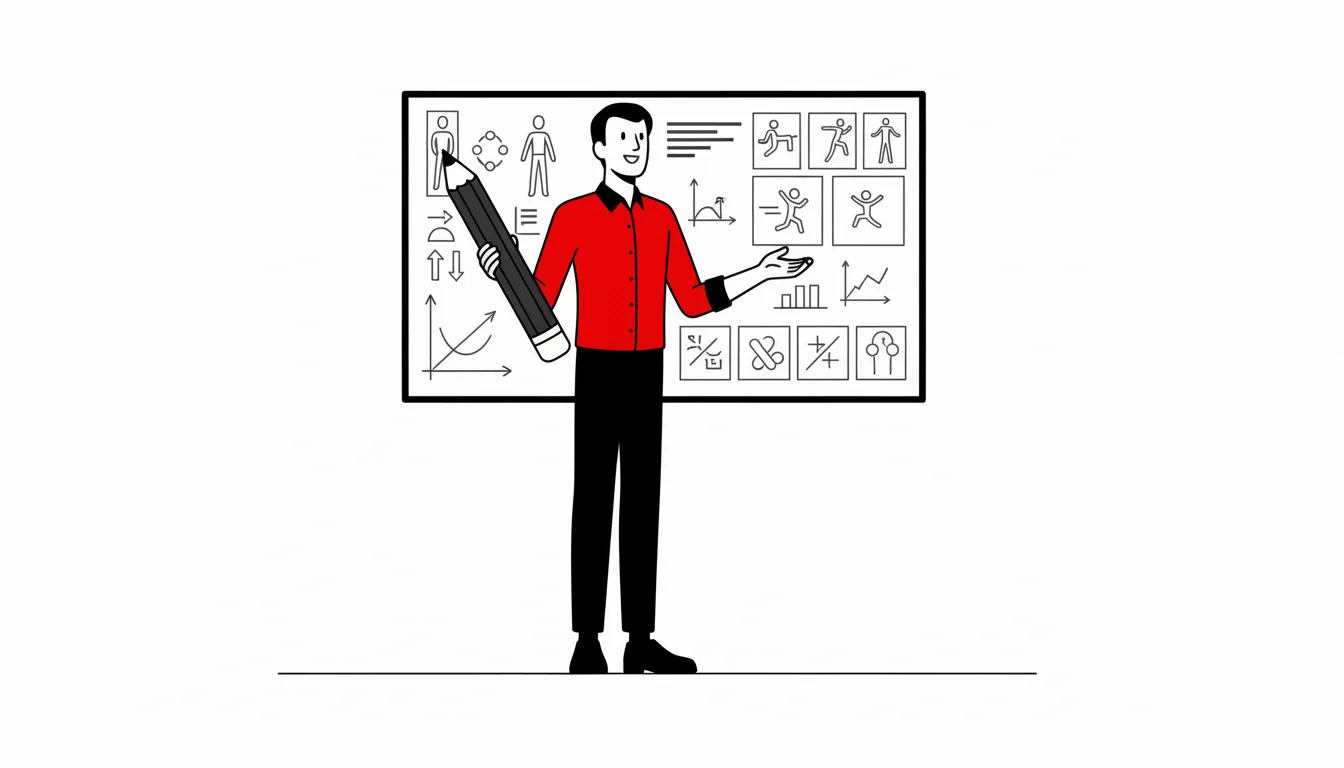
There is a common idea in the creative field: first you make, then, if there is time left or if creation does not pay the bills, you teach. As if teaching were the plan B of those who did not make it in art. It is the opposite: teaching is part of the creative work, and whoever creates already teaches even when they don’t give classes.
Artist or teacher? Both
Art education carries an old tension, which researcher Constance Huddleston Anderson described in 1981 as an identity crisis: is the art educator an artist or a teacher?[1] Practice answers: both. And the two identities do not compete, they are the same thing seen from different angles.
Whoever creates is always forming someone. They form the assistant who watches the color decision. They form the client who learns to read a storyboard (the visual script of the scene). They form the audience that recognizes a framing. Between that and teaching a class, the difference is the degree of intention.
In my twenty-plus years producing, the decisions that taught me the most were the ones I had to explain to someone else.
What teaching changes in those who create
Teaching forces one thing that practice alone does not: clarity. When you execute, you can act on intuition and never need to know why it works. When you have to explain it, intuition becomes process. Or you find out you never had a process at all.
In my case, teaching changed three things:
Visible method. Teaching forced me to name steps I used to do on autopilot. What was feeling became a documented process, and that is how I organized the pipeline I use today.
Doubled repertoire. Every student question tests what I know. When the answer doesn’t come easy, I go back to studying. The studio gains what the class discovers.
Pace. The workshop has another time, the time of learning. Working in it reminds me why haste is a bad advisor in a craft of construction.
In practice: where this happens today
I already told the story of the years of workshops at various institutions in this post. Here, what matters is what came after: teaching left the margin and moved to the center of what I do.
- Courses in animation, screenwriting and Blender, with live classes and small groups
- Fonte, the screenwriting editor I built and use in my classes
- Training at institutions, with workshops and consulting for schools and cultural projects
I am also structuring Ludens, a platform to bring hybrid education to schools and teachers. Teaching is not an appendix to the portfolio: it is a line of work with its own practice.
A bridge for schools and projects
This is the work I do with schools and cultural projects: training designed from studio practice.
If your school or project is planning training in audiovisual, animation or writing, get in touch.
FAQ
Is the artist also a teacher?
Yes. Art education has discussed this dual identity since at least 1981, when Anderson described the identity crisis of the art educator.[1] In practice, whoever creates already forms people around them, from assistants to audiences, and teaching a class is the intentional version of that.
Does teaching hurt creation?
In my case, it did the opposite: teaching brings clarity of process, multiplies the repertoire and brings back ideas that only appear when someone asks. What hurts is teaching without organization, occupying time that production needs.
What is art education?
It is the field that unites art and teaching: forming people through artistic experience, not just technique. In my work, it shows up in workshops, in courses and in the tools I use to teach.
How do I hire training for my school or project?
The contact page is the starting point: write with the audience (age or grade), the goal and the desired period. From there we define the format (a single workshop, a full course or an ongoing program) and the proposal comes with the journey designed.
References
- Anderson, C. H. (1981). The Identity Crisis of the Art Educator: Artist? Teacher? Both? Art Education, v. 34, n. 4, p. 45. DOI: 10.2307/3192553. (The debate over the dual identity, artist and teacher, in art education.)
- Own experience — over 20 years in production, courses and team training (SESC, Cinema Nosso, Cidadela and my own projects); and serving as a teacher in elementary and high school classes.
If your school or project wants training with method, get in touch.
— Ricardo A. B. Graça · ricolandia.com