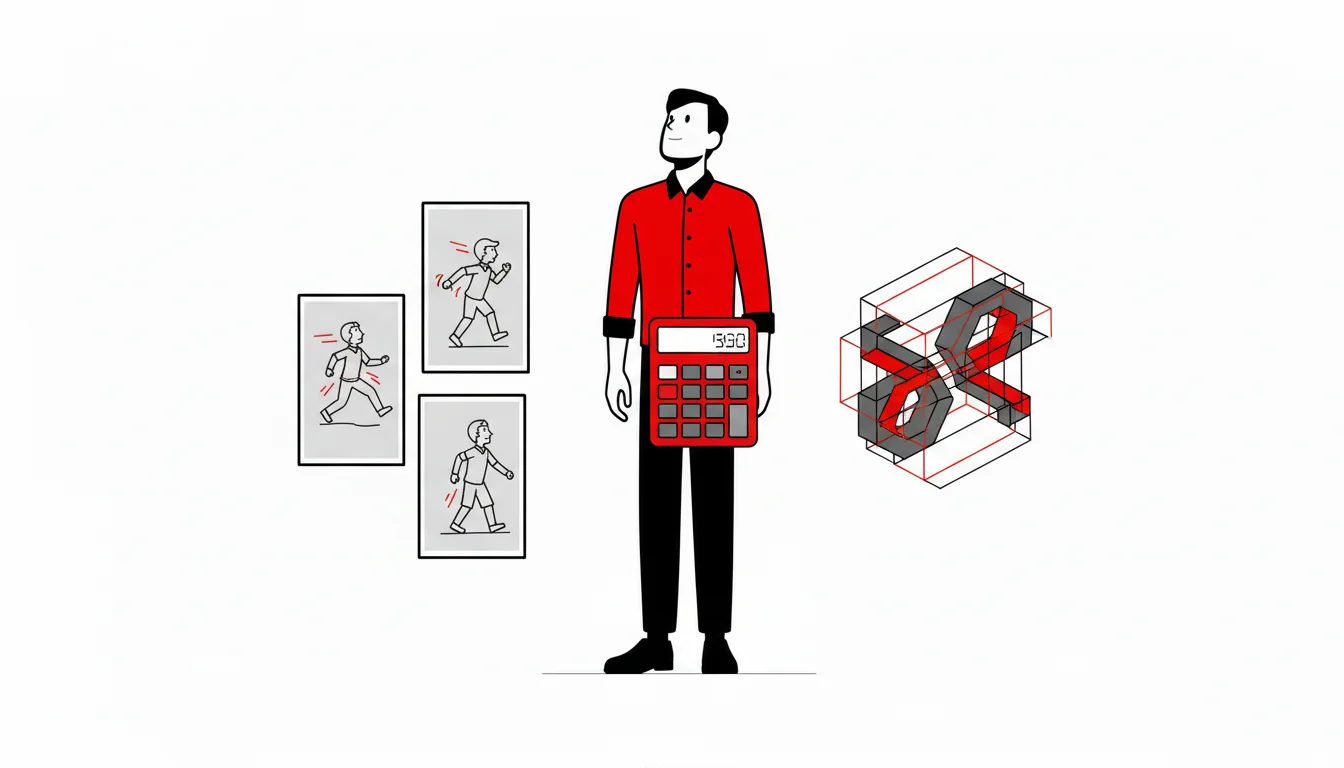
“How much does an animation cost?” is a question I get almost every week. And it almost never comes with the information that defines the answer: the format. 2D animation, 3D animation and motion graphics have completely different cost structures — this guide organizes the ranges, what drives the price, and how to estimate a project without guessing.
Why animation has no shelf price
In live-action video, the camera captures reality and the cost concentrates on production days. In animation, every second is produced from scratch. There is no gain of scale: one frame does not get cheaper because the previous one is done.
Before asking for a quote, define the format — it is what changes the price range by up to 5 times.
One minute of professional animation can cost a few hundred reais or tens of thousands, depending on the technique. For reference, a Wyzowl survey with 242 studios found a median of US$ 5,400 and an average of US$ 10,983 for one minute of animation — with projects ranging from US$ 600 to over US$ 250,000.[1] In the American industry, production cost data compiled by Waterman (2005) also places animation consistently among the most expensive formats.[2]
The three price families
Based on the table I use in my studio, calibrated by what I see practiced in the Brazilian market:
| Format | What it is | Range per minute (R$) |
|---|---|---|
| Motion graphics | Animated diagrams, typography and infographics — no characters | 250 – 800 |
| 2D animation | Drawn characters, frame-by-frame or with a digital skeleton (rigging) | 250 – 800 |
| 3D animation | Volume and depth — modeling, skeleton, lighting and final rendering | 1,200 – 2,800 |
Values for standard 1-minute projects, with voice-over and licensed music included. Rush delivery, extra revisions, complex characters and additional rights fall outside this range.
These ranges are for advertising and digital marketing video. Cinematic production (shorts, features, series) has a different order of cost — it is another production regime, with incomparable crew and timelines.
Motion graphics starts with vectors and typography: less work per second and more predictability — usually the entry point. 2D animation adds character design. 3D is the most expensive family because it adds stages that do not exist in the others — modeling, skeleton, lighting and render — each of them with days of work.
The motion and 2D ranges overlap because a complex motion piece can cost like a simple 2D one. The floor is what differentiates them in most projects.
What drives the price up
Four factors explain almost all variation between animation budgets:
Visual complexity. Drawing style, number of characters, amount of moving elements. An animation with one simple character and a single-color background costs a fraction of a scene with multiple interacting characters and a detailed set. Style choice is not a whim — it is a cost decision.
Duration and volume of work. The two do not move together linearly. A 2-minute video does not cost twice a 1-minute one; a dense minute can take more work than three minutes of direct structure. What you pay for is the production work, and it is not proportional to screen time.
Tight deadlines. Next-day delivery changes everything. Animation production has mandatory stages: storyboard, design, animation, sound, review. Compressing that into days means more people working in parallel, and that has a price.
Revisions and iterations. Every round of adjustments consumes production hours. That is why I don’t start animating without a closed brief: it is what avoids the rework nobody budgeted for.
One detail of how I work that impacts the budget: I have used free software for over 20 years. Tool licenses don’t enter the equation — the value goes to work hours.
AI animation: did the price drop or move?
There is clear demand for “2d animation with ai” and “ai logo animation” in searches. What AI changed was the cost of the draft. Judgment — choosing, correcting, refining — remains human work, and it is what defines whether the result communicates exactly what the brand needs.
If the project can live with “close enough” — a generic scene, an approximate style, no defined identity — AI tools solve it fast and cheap. If it requires a brand, consistent characters and art direction, the work is human curation — and that layer became more valuable.[3]
How to estimate your budget
I built a free budget calculator that estimates production cost based on format, duration and complexity. It does not replace a custom quote, but it gives a concrete starting point for the conversation.
No project fits in a spreadsheet by itself — tell me the scope and I will close the estimate.
FAQ
How much does 2D animation cost?
For standard 1-minute projects, with voice-over and music included, the range is between R$ 250 and R$ 800 per minute. Rush delivery, extra revisions and complex characters fall outside this range.
How much does 3D animation cost?
3D animation starts at R$ 1,200 and goes up to R$ 2,800 per minute in standard projects, because it adds stages that do not exist in 2D: modeling, skeleton, lighting and rendering.
What is the difference between motion graphics, 2D and 3D animation?
Motion graphics animates vectors, diagrams and typography — no characters. 2D animates drawn characters. 3D builds volume and depth. The motion and 2D ranges overlap (R$ 250–800); 3D starts at R$ 1,200.
Is AI animation cheaper?
AI makes the draft and style exploration cheaper, not the judgment. For projects that require identity and consistency, human curation remains the main component of the price.
How do I calculate the cost of an animation?
Use the budget calculator as a starting point — it considers format, duration and complexity. The final price closes with the project scope.
References
- Wyzowl. How Much Does An Explainer Video Cost? Available at: https://wyzowl.com/explainer-video-cost/. (Survey with 242 studios: median of US$ 5,400 and average of US$ 10,983 for 1 minute of animation.)
- Waterman, D. (2005) Movie Production Costs and Animated Movie Data. In: Hollywood’s Road to Riches. Harvard University Press, p. 313-315. DOI: 10.4159/9780674044920-016. (Production cost data for animated movies in the American industry.)
- Own experience — 20 years producing 2D/3D animation with free software.
If your project is a 2D, 3D animation or motion graphics piece, get in touch — with a 15-minute brief I can estimate a real price for your scope.
— Ricardo A. B. Graça · ricolandia.com