If your corporate video didn’t deliver results, the problem probably isn’t the video. The piece can be technically flawless — clear script, good animation, professional voice-over — and still sound like “yet another company video”. The difference between a piece that convinces and one that crosses the screen without leaving a trace usually lies in what comes before it: communication alignment.
The problem: communicating outside-in
Most companies start with the post, the ad, the logo. A need appears — “we need a video” — and production begins before anyone answered the questions that define everything: who we are, what we stand for, what our personality is.
The result is incoherent communication. The piece can be great in isolation and, as a whole, say something the company is not. That’s where production money becomes decoration.
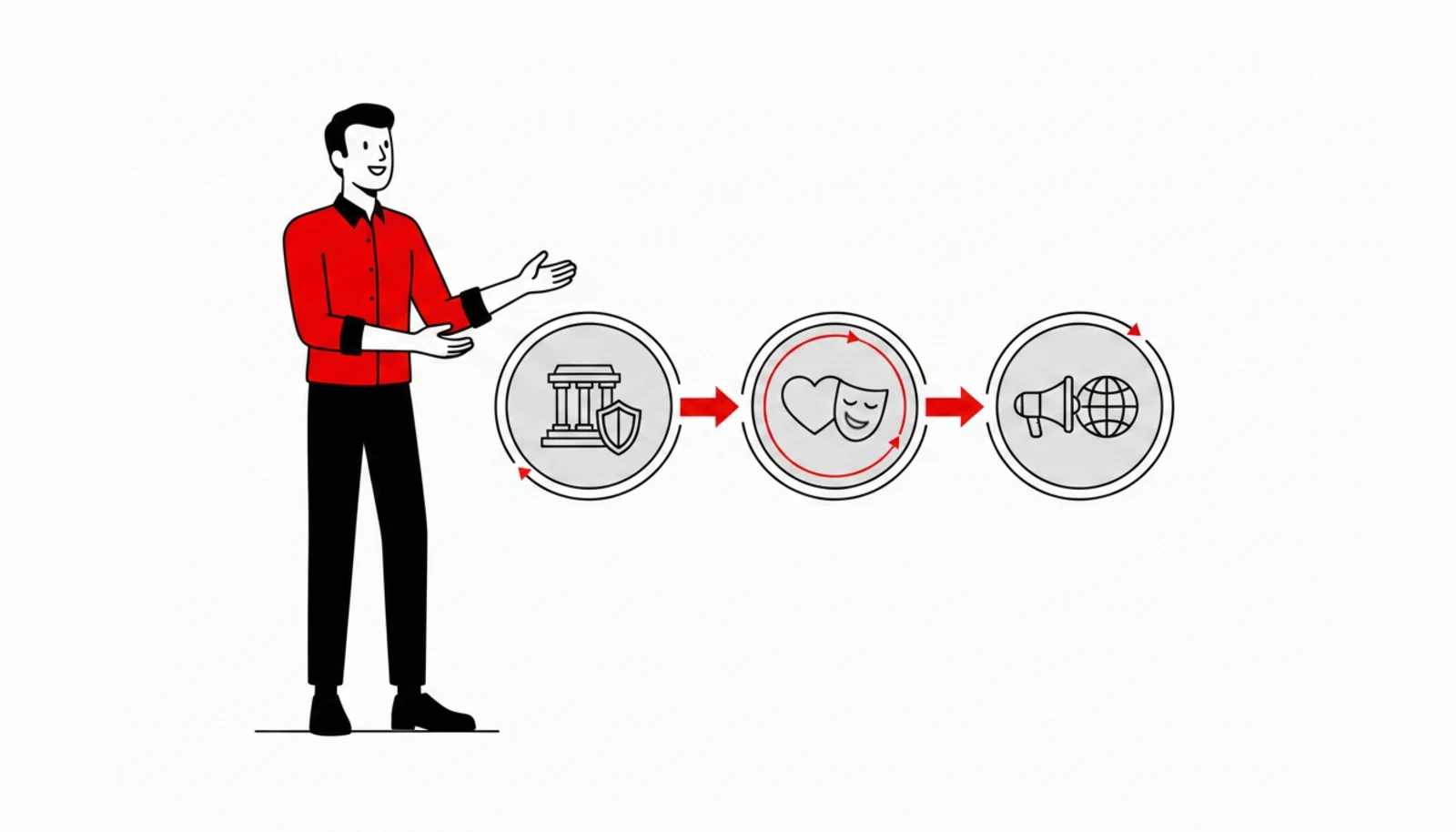
The 3 Spheres Model
I developed this model in my master’s research in Communication, and it is the core of my book Integral Communication. The idea is simple: a company’s communication flows from the inside out, through three spheres that feed each other.
1. Internal Communication — who you are. Company history, mission, vision, values. It’s the foundation of everything. A company that can’t tell its own story has nothing to communicate.
2. Institutional Communication — your personality. Archetypes, brand persona, visual identity, tone of voice. It’s how the company behaves: what it would say, what it would never say, how it signs.
3. External Communication — how you speak to the market. Strategies, campaigns, content, social media and audiovisual production. This is where most companies start — and why most stop halfway.
Each sphere sustains the next. Without the internal one, the institutional is decoration; without the institutional one, the external is noise.
Why videos fail without alignment
Video is the external sphere made tangible — the point where a company speaks to the market with image, sound and motion. When the first two spheres don’t exist, three things happen:
- The tone of voice floats. Without a defined personality, the script adopts the producer’s tone, the competitor’s, or whatever “looks professional” — not the company’s.
- The campaign contradicts the values. What the video says and what the company actually does disagree. The audience notices before the piece ends.
- The team doesn’t recognize the brand. If the people who work there don’t identify with what the video says, the customer won’t either — and internal communication breaks.
Academic research reinforces this view: internal communication is not an isolated department but a network of relationships that sustains the image a company projects.[1] Ignoring that foundation treats the symptom, not the cause.
What changes in practice
The production order is reversed. Before writing the script of a corporate video, the company needs to answer three questions quickly:
- Who are we? History, mission, values — in a few lines, without clichés.
- What is our personality? Tone of voice, visual style, what we would never do.
- Who do we speak to? Audience, moment, goal — and only then the format.
Answering is not a months-long project. For small companies, one honest afternoon of conversation already changes the next script. For larger ones, it’s the starting point of a communication diagnosis — exactly what I do before producing any piece, as I describe in My animation pipeline is mostly free software.
The result shows up in the piece: a corporate video that communicates what the company actually is, one less briefing mistake, and a strong corporate brand that gets stronger with every production — instead of contradicting itself.
Where the model is explained
The full model — with checklists to apply each sphere and a 30-day plan — is in the book Integral Communication: Theory, Strategy and Practical Guide for Companies. If your project needs to start from the foundation before the next piece, get in touch to discuss the diagnosis.
Frequently asked questions
What is the 3 Spheres Model?
It’s a corporate communication model with three layers that feed each other: internal communication (who the company is), institutional communication (its personality) and external communication (how it speaks to the market). The flow is always from the inside out.
What’s the difference between internal and institutional communication?
Internal is the foundation: the company’s history, mission, vision and values. Institutional is the personality built on that foundation: archetypes, brand persona, visual identity and tone of voice.
Do I need to implement everything before producing a video?
No. But you need to answer the three basic questions (who we are, what’s our personality, who we speak to) before the script. One afternoon of conversation changes the next piece; refinement comes with time.
Does the model work for small companies?
Yes. It was developed with micro and small companies in mind — that’s where misalignment shows up the most. The principles apply to any size.
How do I start applying the model?
Start with the first sphere: write in a few lines who the company is, what it stands for and why it exists. Then define the tone of voice. Only then think about the piece. The book provides the step-by-step with checklists.
References
- Welch, M.; Jackson, P. R. (2007) Rethinking internal communication: a stakeholder approach. Corporate Communications: An International Journal, 12(2), 177-198. DOI: https://doi.org/10.1108/13563280710744847
- Graça, R. A. B. (2026) Integral Communication — Theory, Strategy and Practical Guide for Companies. https://www.ricolandia.com/en/books/integral-communication/
— Ricardo A. B. Graça · ricolandia.com