Semiotics in practice: how images speak before the script
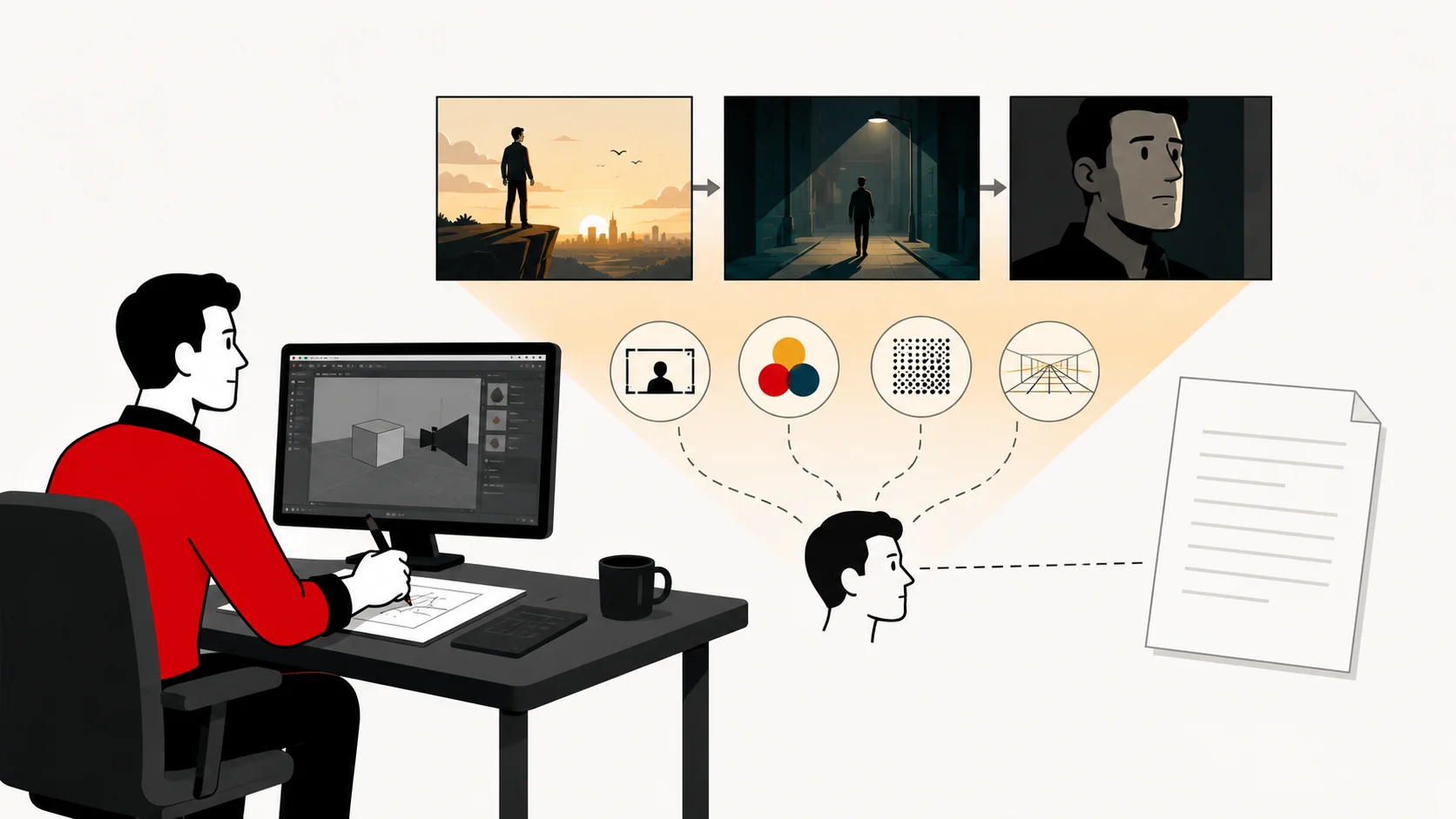
The image speaks before the script — and not as a metaphor. When I open Blender or pick up a pencil, framing, color and texture are already saying something, even when the text is still a blank page. I’ve been researching semiotics of animation cinema for years, and I still think this is the most practical part of my craft.
Most people treat the image as an illustration of the text: first comes the story, then the drawings “translate” what was written. That order is rarely true in real production. On the storyboard, the image decides the rhythm and the mood — and the viewer feels all of it before a single line of dialogue exists.
The script says “the door creaks”. The drawing of the door — the crack in the wood, the light seeping underneath, the crooked handle — already told a story the text doesn’t even try to tell. Barthes called this polysemy: the image holds many possible meanings, and the text anchors one of them. I explore this tension in my visual storytelling guide.
In my process, storyboard and text walk together — and the image often takes the lead. I’ve switched the palette of a film and the whole mood changed without touching a word of the script. Color isn’t decoration: it’s the first sentence of the film.
A concept I use constantly in practice is Peirce’s triad: icon, index and symbol. A red circle on screen can be all three at once. It resembles a sun (icon), it points to danger (index) and, in a given culture, it means “stop” (symbol). When I choose a visual element, I’m deciding which of those layers will speak and when.
Animation goes one step beyond photography: movement. The image not only speaks before the script — it moves and keeps speaking between frames. That’s what no text can fix on paper.
But semiotics is not a recipe. The image speaks, and sometimes it says what you didn’t ask for. A badly drawn character can look sad in a scene that calls for anger. The text’s anchor corrects part of that, but the viewer always carries a meaning you don’t control. Honest craft means accepting that the message is built in reception, not just on screen.
What semiotics gives me isn’t a formula — it’s vocabulary. It lets me see that a lighting decision is a meaning decision. The frame becomes a sentence; the cut, a pause. When a client says “I don’t know why, but this take moves me”, I know what they’re talking about. And I know how to do it on purpose. Anyone who works with visual narrative has noticed the same.
Frequently asked questions
What is semiotics, in short?
It’s the study of signs: how things carry meaning. In images, that involves color, shape, framing, texture and movement — and how the viewer reads all of that together with their own culture.
How does the image “speak” before the script?
Because it carries meanings the text doesn’t need to state. A tight frame communicates tension; a desaturated palette communicates detachment. Effects that exist before and independently of what is said.
What is semiotics for in video or animation production?
To decide consciously what each visual element will communicate — and to diagnose when the image says one thing and the script says another.
Do I need to study semiotics to be an animator or director?
No, and well-trained intuition covers a lot of it. But semiotic vocabulary accelerates what intuition takes years to build.
What is the “anchorage” in Barthes?
It’s the text that fixes one of the possible meanings of a polysemic image — the caption, the dialogue, the title. The anchorage doesn’t create the meaning; it chooses among the ones already there.
References
- Barthes, R. (1964). Rhétorique de l’image. Communications, 4, 40–51. DOI: 10.3406/comm.1964.1027.
- Peirce, C. S. (1931–1958). Collected Papers of Charles Sanders Peirce. Harvard University Press. Classic semiotics work (icon, index, symbol), no DOI.
- Graça, R. A. B. (2026). Own experience: 20+ years producing with free software and master’s research in corporate communication.
I produce animation with free software and treat every image as a meaning decision. Get in touch if you’d like to discuss a project.
— Ricardo A. B. Graça · ricolandia.com