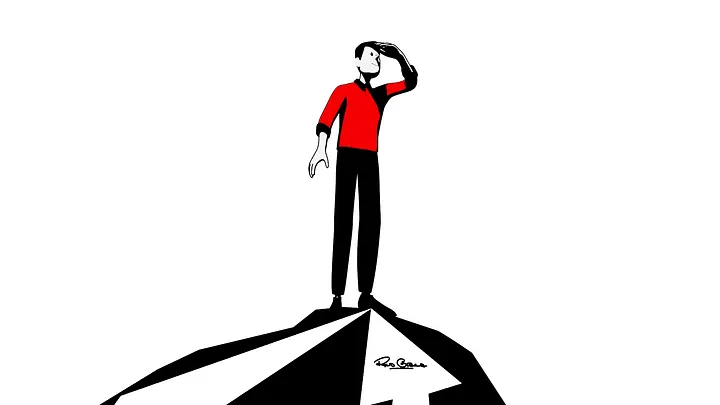
To write a good story, it takes more than just your will or inspiration, and it’s not enough to read one or two authors like the commonly mentioned Joseph Campbell.
As in every technique, writing also has a method, or several methods, that can be learned, studied, and perfected.
The Hero’s Journey
Joseph Campbell, in his book “The Hero with a Thousand Faces”, studied myths from different cultures and identified a common structure that he called the monomyth, or the Hero’s Journey. This structure has 17 stages, grouped into three acts:
- Departure — The hero leaves the ordinary world
- Initiation — The hero ventures into the unknown
- Return — The hero returns with new knowledge
Christopher Vogler, in “The Writer’s Journey”, adapted Campbell’s monomyth for screenwriters, simplifying it into 12 stages that are widely used in Hollywood.
The Three-Act Structure
The most common structure in Western narratives is the three-act structure:
Act 1 — Setup
- Introduction of characters and setting
- Inciting incident that sets the story in motion
- The protagonist decides to act
Act 2 — Confrontation
- Rising action and obstacles
- Midpoint where the protagonist faces a major challenge
- The darkest moment before the climax
Act 3 — Resolution
- The climax where the conflict is resolved
- Falling action
- The new normal for the characters
Key Elements of a Good Story
- Character — A protagonist the audience can relate to
- Conflict — The obstacle that drives the narrative
- Stakes — What the protagonist stands to lose
- Structure — The framework that holds the story together
- Theme — The underlying message or meaning
“A story is not just a series of events. It is events connected by causality.” — Aristotle
Practical Tips for Writers
- Read widely — Study the masters of storytelling
- Write daily — Practice is the only way to improve
- Revise ruthlessly — The real work is in the rewriting
- Get feedback — Share your work with trusted readers
- Study structure — Understand the frameworks that work
If you’re developing a script for a corporate video or campaign, try the Script Structure Generator to structure your narrative in minutes.
Remember: a great story is not born, it is crafted. And like any craft, it requires dedication, study, and practice to master.
I produce animation with free tools. Get in touch if you’d like to discuss your project.
— Ricardo A. B. Graça · ricolandia.com