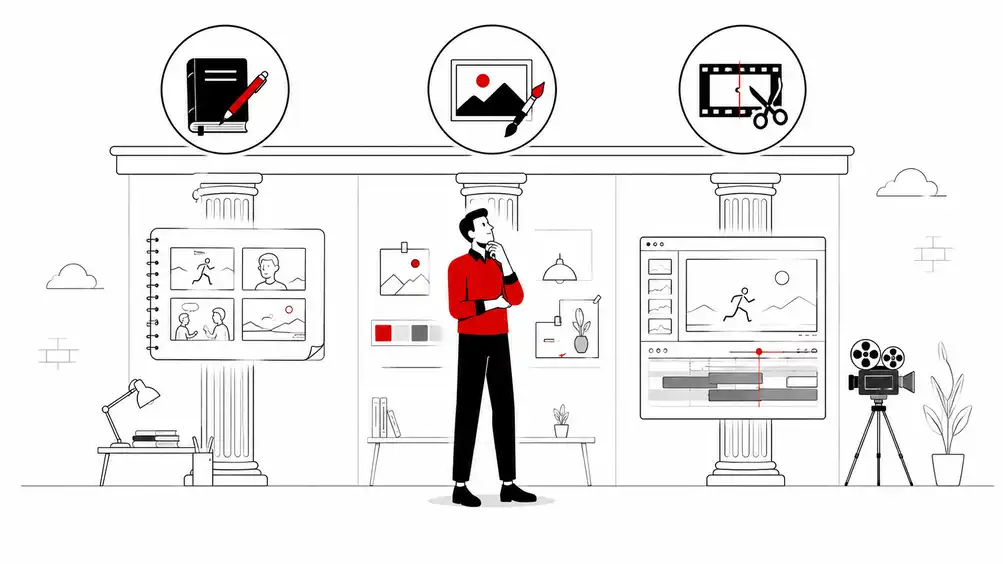
There is a common illusion in filmmaking: that technical quality sustains a project. Good camera, beautiful render, well-executed effects. After years of producing commercial and authorial animation, I can say with some certainty that this is not how it works. Technique without narrative structure is decoration. The three pillars below are what actually sustains a project — and what I analyze first when something isn’t working.
Script
Before any framing, there is a question that needs to be answered: what does this story want from the viewer? Not what it wants to tell — what it wants to provoke. Dramatic arc, character construction, narrative rhythm — everything serves that answer. A script that doesn’t know what it wants from the viewer will result in a project that technically works and dramatically says nothing. It’s the most common problem and the hardest to diagnose mid-production.
Art Direction
Every element in the frame is information. Color, texture, lighting, proportion — everything communicates before any dialogue begins. In animation this is even more evident because every element was placed there: there is no set accident, no light that came through the window without someone deciding it. A palette defined in pre-production is not aesthetics — it’s visual script. And when art direction is aligned with narrative, post-production stops being correction and becomes refinement.
Editing
Editing is where the film breathes — or suffocates. The rhythm of the cut does not illustrate emotion: it is emotion. An action scene with cuts that are too long loses tension; a drama cut too fast doesn’t let the viewer feel the weight of the moment. But beyond rhythm, editing decides what the viewer knows and when they know it — and that is pure narrative power. It is the stage I respect most and where I learn most in every project.
A practical exercise I recommend: watch a short film without sound and write down what you understood from the images alone. Then watch it again with audio. The gap between what you inferred and what is actually happening reveals how well your art direction and editing are communicating — or failing to communicate.
It’s not about the camera. It never was. It’s about the set of decisions that transforms images into experience — and the awareness that each of those decisions is the responsibility of whoever signs the project.
If you’re just starting out, I recommend also reading about the journey to a good story, where I dive deeper into character building and dramatic structure.
— Ricardo A. B. Graça · ricolandia.com